
AI automation in a company is the use of artificial intelligence to carry out repetitive tasks on its own that previously required a person: reading documents, preparing quotes, handling inquiries or retyping data between systems. Unlike classic automation, it copes with natural language and exceptions, so it covers processes too variable for rigid rules.
WeAreFuture is a Polish AI advisory and implementation firm based in Warsaw. This guide is based on our implementations at manufacturers, in finance and in retail. The problem today is not that there is nothing to automate. It is that companies start with the wrong processes, buy a tool instead of solving the problem, and after three months have a working demo nobody uses. The scale of the phenomenon is documented: according to the MIT NANDA report, 95% of generative AI pilots deliver no measurable effect on the bottom line (2025).
This guide is about which process to take on first, what not to touch and how to check whether it paid off - before you spend more.
Want to test this on your process, not in theory? We do a PoC of one agent in 2 weeks - on your data, with the effect calculated before the decision on scale. See how we run AI implementations.
AI automation vs classic automation - what has changed
Classic automation (including RPA) works great where the process is structured and predictable: the same fields, the same layout, zero interpretation. A robot clicks, retypes, moves things. The trouble starts at the first exception - a different invoice format, an attachment in an email instead of in the system, a sentence written like a human would write it. Then the rule falls over and a person’s input is needed again.
AI automation moves this boundary. A model understands text, extracts data from a non-standard document, summarizes an email thread, classifies a ticket by its content. This makes it possible to automate processes that until now were too non-standard for rules - and that is a qualitative change.
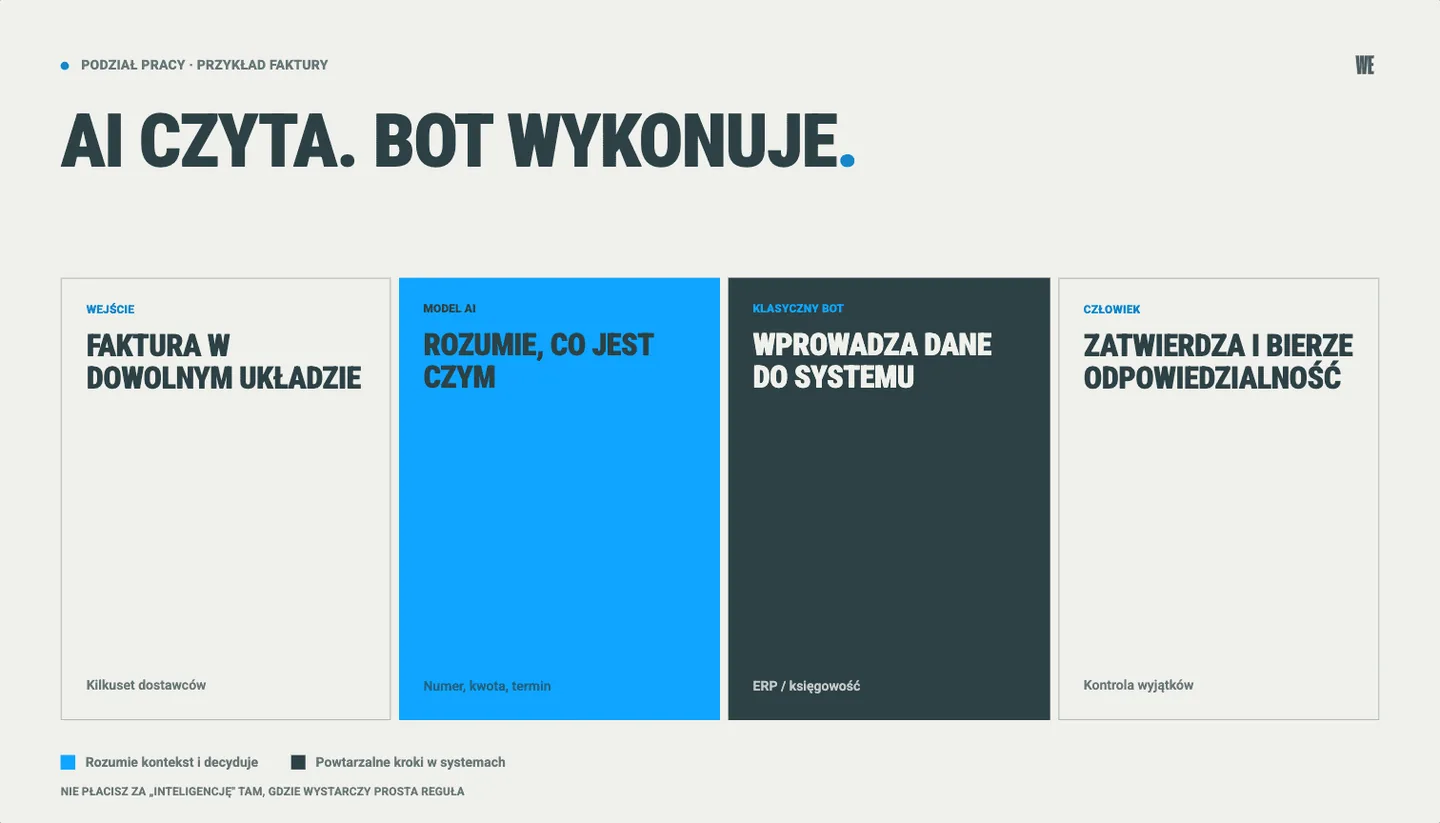
A simple example: a company receives invoices from several hundred suppliers, each in a different layout. The classic rule works until the layout changes - with a new format someone has to fix it or retype the document by hand. An AI model reads the same fields regardless of layout, because it understands what an invoice number or a payment due date is, not only where on the page they usually sit. AI automation therefore scales to the variety at which classic rules stop.
These two worlds do not exclude each other, they complement each other: AI makes the decision and reads the context, classic automation carries out the repetitive steps in the systems. The best implementations combine the two. In invoice handling it looks like this: an AI model reads the document and understands what is what, and a classic bot enters the ready data into the accounting system and watches the status. Each part does what it is best at - you do not pay to build “intelligence” where a simple rule is enough. We break down the difference between an AI agent and automation in more detail in a separate post.
Which processes to automate first - the WeAreFuture selection filter
The most common mistake is starting with a process that seems important and difficult to the organization. The order should come from a hard calculation. Use the WeAreFuture filter - you rate a process on four dimensions, on a scale of 1-5, where 5 always means a better candidate:
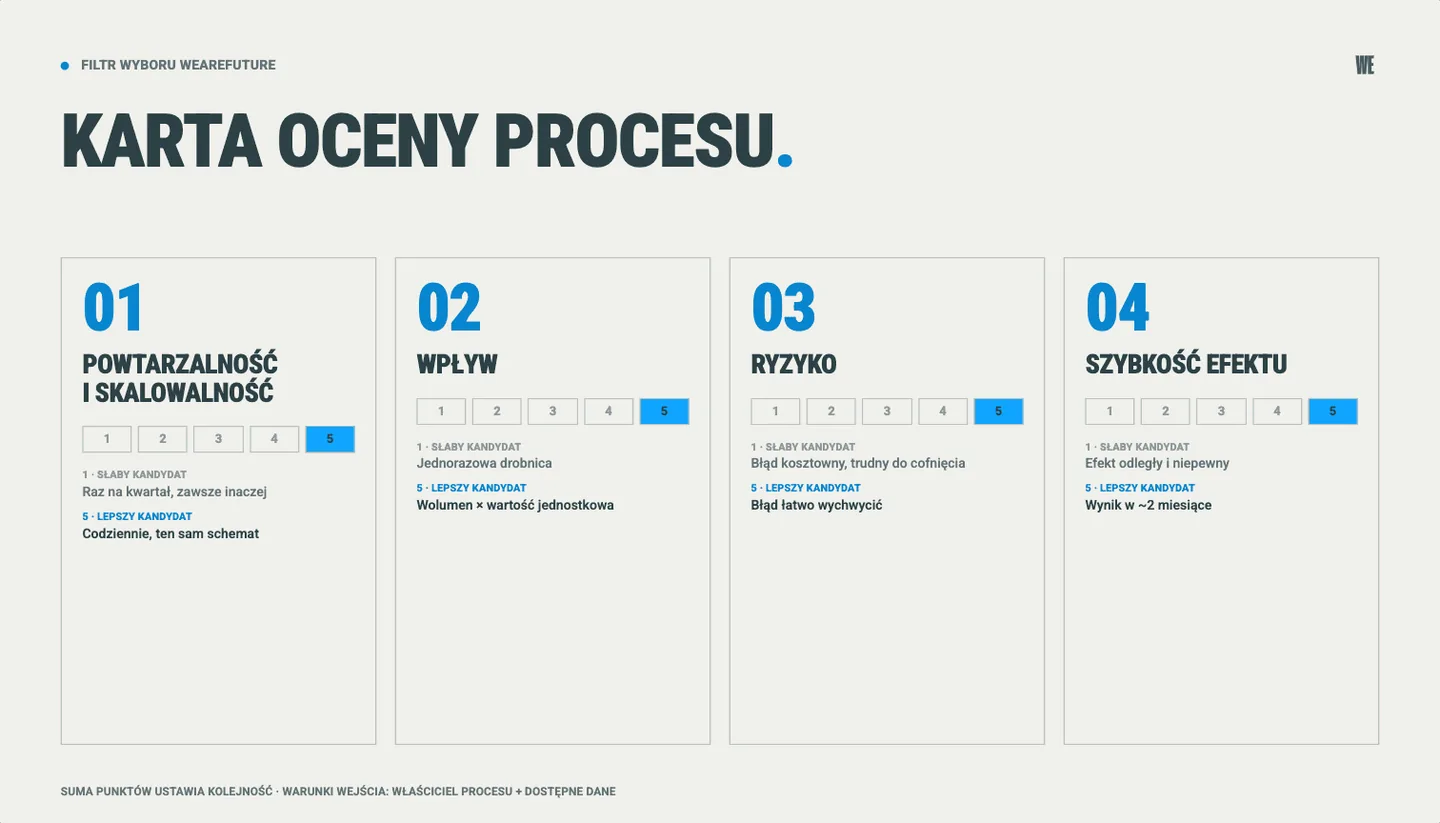
Repeatability and scalability - how often does the process run in the same form, and can it be replicated to further cases? Daily, the same way and easy to scale (5), or once a quarter, different every time (1)?
Impact - by how much does the process improve time, cost, quality or the customer experience? You can estimate it by volume (hundreds of runs a month), by time consumption (how many hours it eats) or by the value of a single case (one tender worth millions). Impact is the product of volume and unit value - many simple, cheap cases and a handful of very high-value cases can give the same result (5); a one-off trifle (1).
Risk - what happens when the AI gets it wrong? Low risk because the error is easy to catch and fix (5), or high because a mistake is costly and hard to undo, for example in compliance (1)?
Speed of effect - will you see a result quickly, within about two months (5), or is the effect distant and uncertain (1)?
Add up the scores from the four dimensions. The processes with the highest total - high repeatability and scalability, large impact, low risk and a fast effect - are your first wave. The rest wait: they either go to classic automation or stay with a person.
How it works on an example. Handling requests for quotation (RFQ) gets high repeatability and scalability (daily, a similar pattern), large impact (many requests, some of high value), low risk (a salesperson approves the quote anyway) and a fast effect (visible within weeks). A high total on all four dimensions, so it goes first on the list.
Impact does not have to come from volume alone. A process in which you have to pick out a dozen to a few dozen tender inquiries worth millions from thousands of notices has high impact thanks to unit value - at one of our distribution clients, automated tender screening caught a single order of very high value that a person might have missed. At the other pole is handling thousands of simple, cheap requests: also high impact, only drawn from volume.
Settling business trip expenses, on the other hand, has high repeatability but low impact and higher risk (tax settlements) - a lower total, so it waits. The same filter, different verdicts, a choice based on clear decision criteria.
On top of that come two entry conditions without which even a high total means nothing: the process must have an owner (someone is responsible for the result and will accept the change) and available data in a form a tool can connect to. If either is missing, it is not a candidate for automation - it is a candidate for tidying up.
Examples by department - what actually gets automated
Sales and quotes. Qualifying inquiries, preparing quotes, handling RFQs. The classic bottleneck: a request for a quote arrives, someone has to pull out the data, match the product and put the quote together. At a Polish manufacturing company that handles about 2,000 requests a month, we automated the RFQ handling process - the time to prepare a response fell from several days to around one day (WeAreFuture data). Not because AI wrote the quote for the salesperson, but because it took off them all the tedious work around quote handling. We lay out the architecture of such an implementation in the step-by-step guide to AI implementations.
Customer service. Ticket triage (recognizing topic and priority from the content of an email), a first line of response to repeatable questions, summarizing long threads for the agent who takes over the case. The effect is fastest where tickets are numerous and repetitive. Typically part of the requests close without a person, and the harder ones reach the agent already described and organized, so the first reply to the customer is ready in minutes, not hours.
Finance and documents. Reading invoices and documents in non-standard formats, preliminary coding, catching discrepancies, preparing data for posting. This is an area where AI manages where classic OCR and rules gave up - because documents rarely look the same. With hundreds of documents a month, what counts is not only time but also that the model consistently catches deviations (a missing line item, an amount inconsistent with the order) that escape a person.
HR. Initial CV screening against specific requirements, answers to employees’ repeatable questions (leave, benefits, procedures), preparing onboarding packs. Note: recruitment is a sensitive area - AI supports a person in selection, it does not make the decision for them. Well-run automation takes repetitive correspondence and the initial sorting of candidates off the HR team, and leaves the decision to invite someone to an interview with the recruiter.
The common denominator of these examples: AI does the boring part of the process, a person makes the decision and takes responsibility. That last element is a necessary condition for the implementation to last - which is why alongside automation we run AI adoption programs for the teams that are to use it. When such a process runs on its own from start to finish, we are talking about an AI agent.
What NOT to automate
Some processes look like great candidates for automation and turn out to be a budget trap. We do not take on:
Processes without an owner. If nobody is responsible for the result, there is nobody to accept the change or maintain the solution. The automation will die at the first change in the company.
Chaos instead of a process. Automation entrenches whatever it finds. If the process is inconsistent and done differently every time, tidy it up first, then automate.
Processes without data. If the data exists only in people’s heads, on paper or scattered across ten places with no access, the tool has nothing to work with. That is a data cleanup project, not an automation one.
Decisions with a high cost of error and no human control. Wherever a mistake is costly or hard to undo, AI can prepare and recommend, but we leave the final decision to a person.
This list is not settled forever: most of these processes will come back into play for AI once you have sorted out the owner, the process and the data.
How much AI automation costs - three models and ranges
Cost depends not on “AI” but on how complex the process is and how deep you have to go into the company’s systems. We work in three models:
Quick improvements - a single, well-bounded process (for example one type of document, one department). We usually start with a PoC to calculate the effect before moving to scale. Roughly PLN 10-30k (WeAreFuture estimate).
Complex areas - a process that runs through several systems, with integrations and business rules. More work on data and connections than on the model itself. Roughly PLN 35-100k and more, depending on the number of integrations (WeAreFuture estimate).
Capacity (a team on a subscription) - when there is a lot to automate and you want a steady pace of implementations instead of individual projects. Billing for the availability of the team, not for a single delivery. Usually from a few thousand PLN per month for a fixed package of hours (WeAreFuture estimate).
What pushes the price up the most: the number and age of the systems you have to connect to (an old ERP with no API can cost more than the model itself), compliance and audit requirements, the quality of the input data and whether the process has to be tidied up first. Pulling it down: a narrowly bounded scope, a ready API and one decision-making owner on the client’s side. That is why two companies with “the same” process can get quotes that differ several times over - you pay for context, not for the model itself.
A rule we repeat to clients: do not buy scale until you have the effect calculated on one process. A PoC of one agent in 2 weeks costs a fraction of a full implementation and answers the most expensive question - whether it is worth it at all. If you do not know which process to start with, that is a job for a readiness audit - we describe it in AI consulting and strategy.
With agents the same rule has its price. Check how much an AI agent costs in three layers, from PoC to maintenance.
A recommendation on the order: start with quick improvements to build momentum and trust in AI in the organization, and plan complex areas and larger implementations in the background. The first calculated success on a small process opens the budget and the consent for the rest - which is why we prioritize not by what is most impressive but by what will deliver a measurable result fastest. Ultimately individual automations work on a shared AI Engine: a company context used by people and agents, that is data about customers and products, procedures and decision rules. It is a coherent architecture instead of a collection of unrelated tools.
How to measure the effect - before/after metrics
Automation without measurement is an expense, not an investment. Before we start, we set the baseline and two thresholds:
Before/after metrics - the same numbers counted the same way before and after implementation. Most often: process turnaround time, number of cases handled per person, share of cases handled without a person, number of errors, unit cost of the operation.
Success threshold (minimum) - the level below which the implementation makes no sense at this stage. Set in advance, it protects against an argument about results after the fact.
Target - the level we are aiming for, which justifies scaling to further processes.
Separating the minimum threshold from the target matters, because it protects against two traps: declaring success prematurely and writing off prematurely a project that needs one more iteration. A well-designed PoC has these numbers defined before we write the first line.
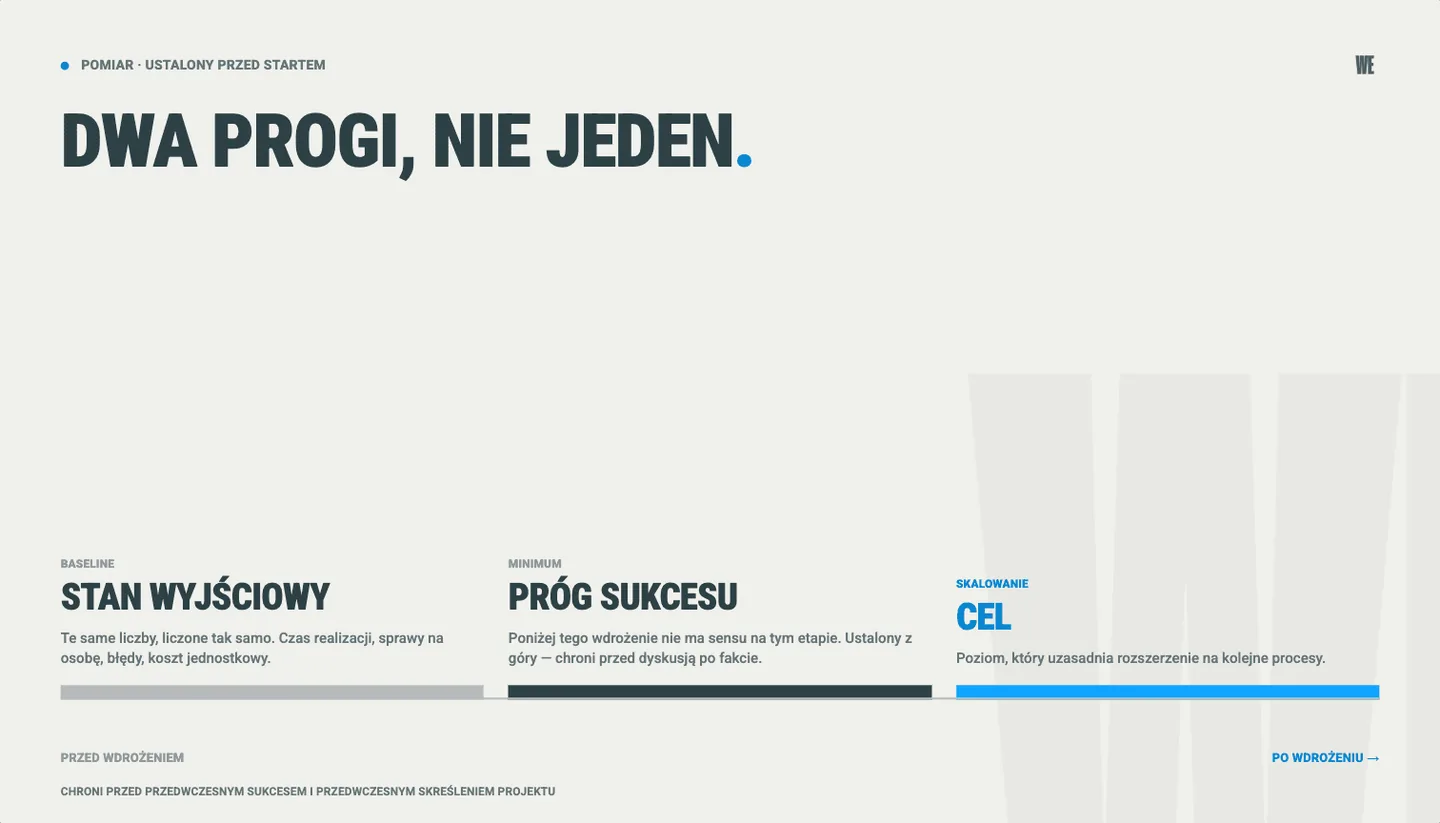
Take the RFQ handling process. Baseline: response preparation time counted in days and, say, a dozen or so quotes a month per person. We set the success threshold at a clear reduction in time - below that it was not worth starting. The target is a reduction to one day and a larger number of quotes handled without adding people. Only with such numbers on the table is the conversation about scaling to further processes a conversation about facts, not impressions - and you carry the same approach over to customer service, finance or HR.
The market background is telling here: about 23% of Polish companies use AI today, and process automation is one of the most commonly implemented uses (a study by PARP, the Polish Agency for Enterprise Development, and Jagiellonian University, 2026). The advantage is still there to be taken, but the winners are those who measure, not those who buy the most licenses.
Don’t guess which process pays off - calculate it. In 2 weeks we will do a PoC of one agent on your data, with before/after metrics and a recommendation on what next. See the scope and billing models of AI implementations.
Frequently asked questions (FAQ)
Where do you start with AI automation?
With one process that is repeatable, has high impact (from volume or from value), an owner and available data - and where an error is easy to catch. Rate candidates on four dimensions: repeatability and scalability, impact, risk, speed of effect. Add up the points, pick one process and do a PoC before you think about scale.
How much does AI automation cost?
It depends on the complexity of the process and the number of integrations. We work in three models: quick improvements for a single process (roughly PLN 10-30k), complex areas running through several systems (PLN 35-100k and more) and capacity, that is a team on a subscription (from a few thousand PLN per month). We always start with a PoC, which costs a fraction of a full implementation and answers the question whether it is worth scaling at all.
Which processes are automated fastest?
Those that are repeatable and based on documents or text: handling RFQs and quotes, triage and first-line customer service, reading invoices, answers to employees’ repeatable questions. The more standardized the input, the faster the effect.
How does AI automation differ from RPA?
RPA performs rigidly defined, repeatable steps in systems and falls over on exceptions and non-standard data. AI automation understands natural language and copes with exceptions, so it covers processes too variable for rules. It is best to combine both approaches: AI reads and decides, RPA executes.
When does automation not pay off?
When the process has no owner, is chaotic instead of structured, there is no available data, or the risk of error is high and there is no way to put in human control. In those cases you first tidy up the process and the data, and only then automate.
Sources
PARP and Jagiellonian University, Artificial Intelligence in Companies: Adoption Readiness, Competencies and Needs. BKL Research Report (2026) - about 23% of companies use AI, process automation among the most common uses. parp.gov.pl
MIT NANDA (A. Challapally, C. Pease, R. Raskar, P. Chari), The GenAI Divide: State of AI in Business 2025 (2025) - 95% of generative AI pilots with no measurable effect on the bottom line. report coverage, Fortune
