
A voicebot is a system that holds a phone conversation with a person: it recognizes speech, understands intent and replies with synthesized speech. The idea is not new: companies have used IVR hotlines (“press 1 to...”) for years, along with early voicebots that stuck to a rigid script and reacted only to keywords. The topic is back because language models understand free-form speech, and speech synthesis sounds natural enough that talking to a bot no longer feels like picking options from a menu. Today a voicebot handles repetitive conversations: booking appointments, confirming orders, first-line support. The limit is no longer voice quality, but how ready the company's systems are for integration and what these conversations cost.
We write from an implementation perspective: WeAreFuture is a Polish AI consulting and implementation firm based in Warsaw that runs AI agent projects, including voice agents, from choosing the scenario to measuring the outcome.
The budget in brief: a minute of an inbound call in Polish costs roughly USD 0.10-0.25 net, and a minute of an outbound campaign to mobile numbers USD 0.16-0.46 net, in both cases after adding telephony and the language model to the voice provider's rate. An orchestration platform, if you use one, adds another USD 0.05-0.07 net. By our estimates, a pilot of one scenario costs PLN 15-40k net, and a production implementation with integrations PLN 60-150k net. Prices as of August 2026.
A voicebot demo impresses every audience today. The voice sounds natural, the bot doesn't lose the thread, you can interrupt it mid-sentence. The trouble is that the demo shows the layer that is no longer technologically hard. What remains unclear is what the demo doesn't show: where the bot gets order data from, who is responsible for the increasingly rare but still unavoidable hallucinations, and where the call recording ends up. Since August 2026 there is one more question: does the caller even know they are talking to an AI system?
If you are wondering whether there is anything to automate in your phone process at all, book a call: 30 minutes, no commitment.
What an AI voicebot can do in 2026, and what it still can't
It can do three things that were a problem just a few years ago. It speaks Polish well enough that the caller doesn't hang up after the first sentence. It reacts quickly enough that the conversation has no unnatural pauses. It lets you interrupt it and gets back on track.
On latency, check what exactly the number in the vendor's materials measures. ElevenLabs quotes about 75 ms for the Flash v2.5 model, but that is a measurement the vendor explicitly labels as excluding network and application latency: the processing time of the speech synthesis model alone, not the time it takes for the answer to reach the caller over the phone. The target for a full conversational turn is an order of magnitude higher: the same vendor says a natural-sounding voice agent usually aims for time to first audio below 800 ms at the median and below 1.5 s at the 95th percentile. When choosing a vendor, ask about the response time of the whole agent in production conditions, not about model latency.
There are also areas where a voicebot still does poorly. Negotiation and concessions to the customer are beyond it: it will react to what it hears, but it won't judge the situation well enough to offer a discount or change contract terms. The same goes for an upset caller who speaks chaotically and jumps between topics: the bot will handle a simple interruption, but not several issues thrown into one sentence, and it finds it harder to separate emotion from content. Without access to the system with the order status or the customer's balance, the bot stays polite but helpless: it will say it will look into the matter and call back, instead of solving it right away. And as with any AI implementation: no voicebot will replace a process the company doesn't have or that nobody has described.
What companies use voicebots for
The common denominator of sensible use cases today is this: the conversation is short, repetitive and has a goal that can be checked in a system the bot has access to.
Booking and reminding about appointments. Clinics, garages, service centers. The bot calls, confirms the slot, reschedules or cancels and records the result in the calendar. Here we look for the outcome mainly in fewer wasted slots in which nobody was served.
First-line support. The bot answers immediately, with no queue, establishes what the call is about, handles simple matters and passes multi-issue ones to a person together with the context, so the customer doesn't have to repeat everything from the start. Flight, order or parcel status: most such calls rely on unambiguous data in systems that are easy to connect to the bot.
Order and delivery confirmations. A thirty-second call, with the result recorded in the system: confirmed, rescheduled, needs follow-up.
Recruitment screening. An initial conversation with closed questions when application volume is high. Here, however, you need to know one thing: recruitment is an area where EU law treats AI much more strictly than ordinary customer service. The heavier regime applies there from December 2027, and the obligation to say that the caller is talking to an AI system is only a foretaste of it. This scenario starts with a lawyer, not a demo.
Soft debt collection. A first contact reminding about a payment, with an option to switch to an agent immediately. The limit here is set by the purpose of the call, and the tone and frequency of contact are an area where it is easy to run into consumer protection rules. Have a lawyer qualify the specific scenario before you start.
In conversations with clients we most often point to the first two use cases. Left off the list: relationship-based sales, complaint handling and anything that requires empathetic judgment of the situation. Not only because the technology isn't ready for it, but also because callers are only getting used to free-form communication with AI systems. Conversations that require understanding are not the first ones in which to get them used to it.
Voice engines: what to choose for Polish
It looks like a technical decision, but the consequences are about cost and regulation, so it is made at board level, not in the server room. Prices and features as of August 2026, net amounts, to be confirmed with the vendor on the day of purchase.
Engine | Polish | Billing model | Best for | What it doesn't do well |
|---|---|---|---|---|
ElevenLabs (ElevenAgents) | yes, through multilingual models | USD 0.08 per minute of conversation; language model and telephony billed separately | the shortest path to a working hotline: telephony (Twilio, SIP) is built into the API, as with Vapi and Retell | EU data residency only in Enterprise; zero retention mode has to be switched on separately |
Azure AI Speech / Voice Live | TTS USD 15 per 1 million characters for neural voices and USD 22 for Neural HD, STT approx. USD 1 per hour; the Azure price list shows amounts after you select a region and currency, so confirm them on the day of purchase | companies already embedded in Azure, with a requirement for one vendor and one compliance setup | three dedicated pl-PL voices is not much, so the bot sounds like other bots; a wider choice of voices requires the multilingual Dragon HD Omni voices, and a custom voice is a separate cost and a separate application | |
Google Cloud TTS (Chirp 3 HD) | approx. USD 30 per 1 million characters for Chirp 3 HD, approx. USD 4 for older Standard voices (Google price list) | projects where the bot shouldn't sound like every other bot | speech synthesis only: you put recognition, the language model and telephony together yourself | |
Deepgram | recognition yes, synthesis no | STT for Polish from approx. USD 0.006 per minute, approx. 0.009 at the regular price (Deepgram price list) | low-cost transcription of Polish calls, including for analysis after the fact | Aura TTS doesn't speak Polish, so you have to buy synthesis elsewhere anyway |
You choose the engine based on the security team's constraints and the existing stack, not on how the voice sounds in a demo.
What a voicebot costs, layer by layer
The most common budgeting mistake is to take the per-minute rate from the voice provider's price list and multiply it by the number of call minutes, while the actual bill has four layers. Net amounts, as of August 2026.
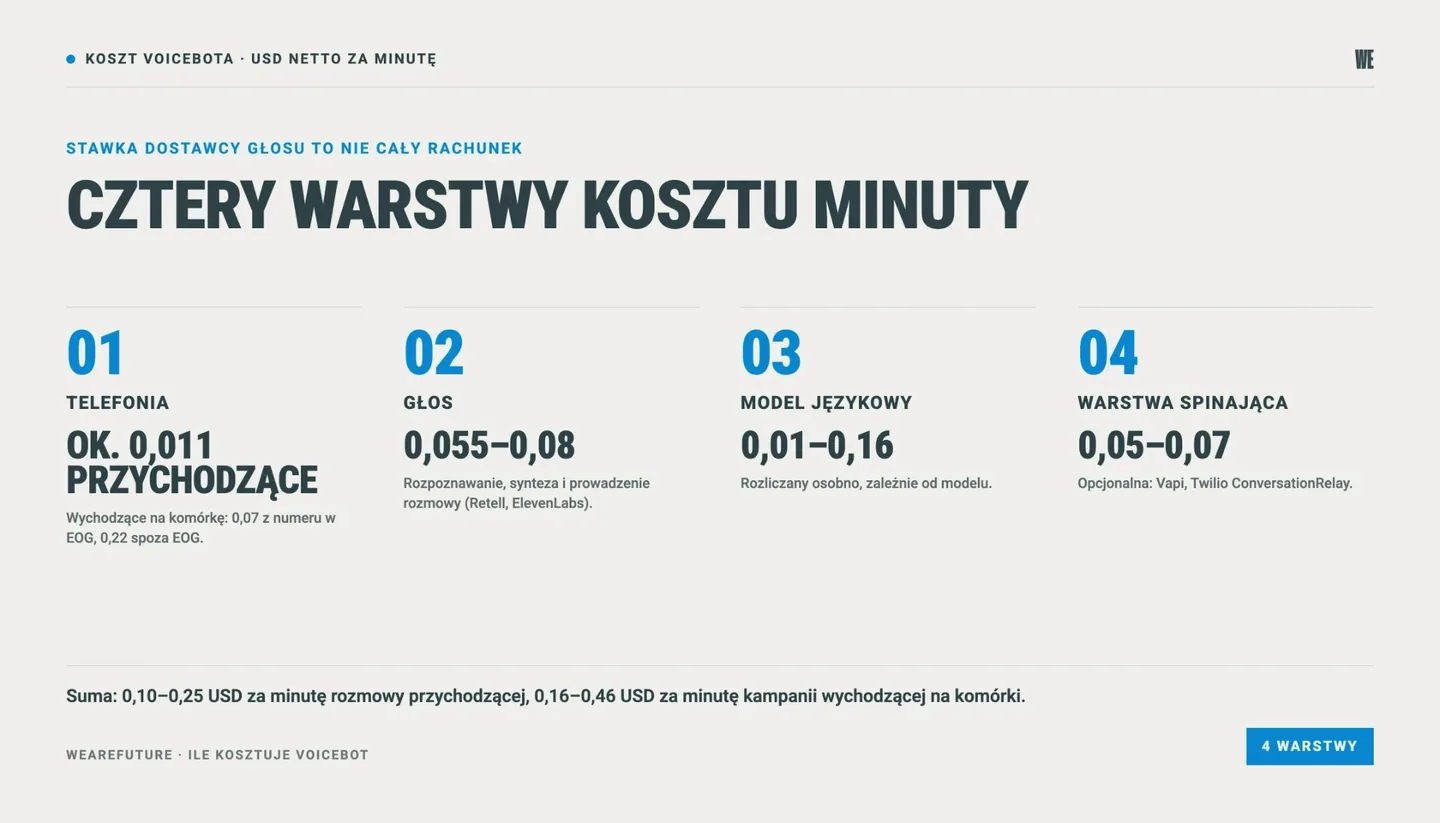
Layer | USD per minute | Note |
|---|---|---|
Telephony, inbound call to a Polish mobile number | approx. 0.011 | the Twilio price list for Poland lists only mobile numbers; the number itself is USD 4 per month |
Telephony, outbound call to a Polish mobile | 0.22 from outside the EEA, 0.07 from a number in the EEA | this one architectural decision changes the line item threefold |
Voice: recognition, synthesis, conversation handling | 0.08 with ElevenLabs, from 0.055 with Retell | the ElevenAgents rate on a monthly plan and after exceeding the minute limit; with annual billing a minute included in the plan comes to approx. 0.067. With burst enabled, calls above the concurrency limit are charged double |
Language model | 0.01-0.16 | billed separately, depending on the model; the range covers models suitable for holding a conversation, based on Retell's public price list. The cheapest models on the list go down to 0.003 |
Orchestration layer (optional) | 0.05-0.07 |
Adding up telephony, voice and the language model, a minute of an inbound call in Polish costs roughly USD 0.10-0.25, and a minute of an outbound campaign to mobile numbers USD 0.16-0.46, depending on whether you call from a number in the EEA and how expensive the language model is. An orchestration platform adds USD 0.05-0.07, and burst, when enabled, charges the double voice rate for calls above the concurrency limit: such an inbound minute reaches approx. USD 0.33.
The more expensive the scenario, the smaller the share of the bill that goes to the voice provider. For an outbound campaign from a number outside the EEA with an expensive language model, it drops below one fifth, and telephony alone then costs almost as much as the whole AI stack combined. For the same campaign from a number in the EEA with a cheap language model, it is still half the bill. That is why you calculate the minute for a specific scenario, not for voicebots in general.
When a voicebot does NOT make sense
Four situations in which we advise against it.
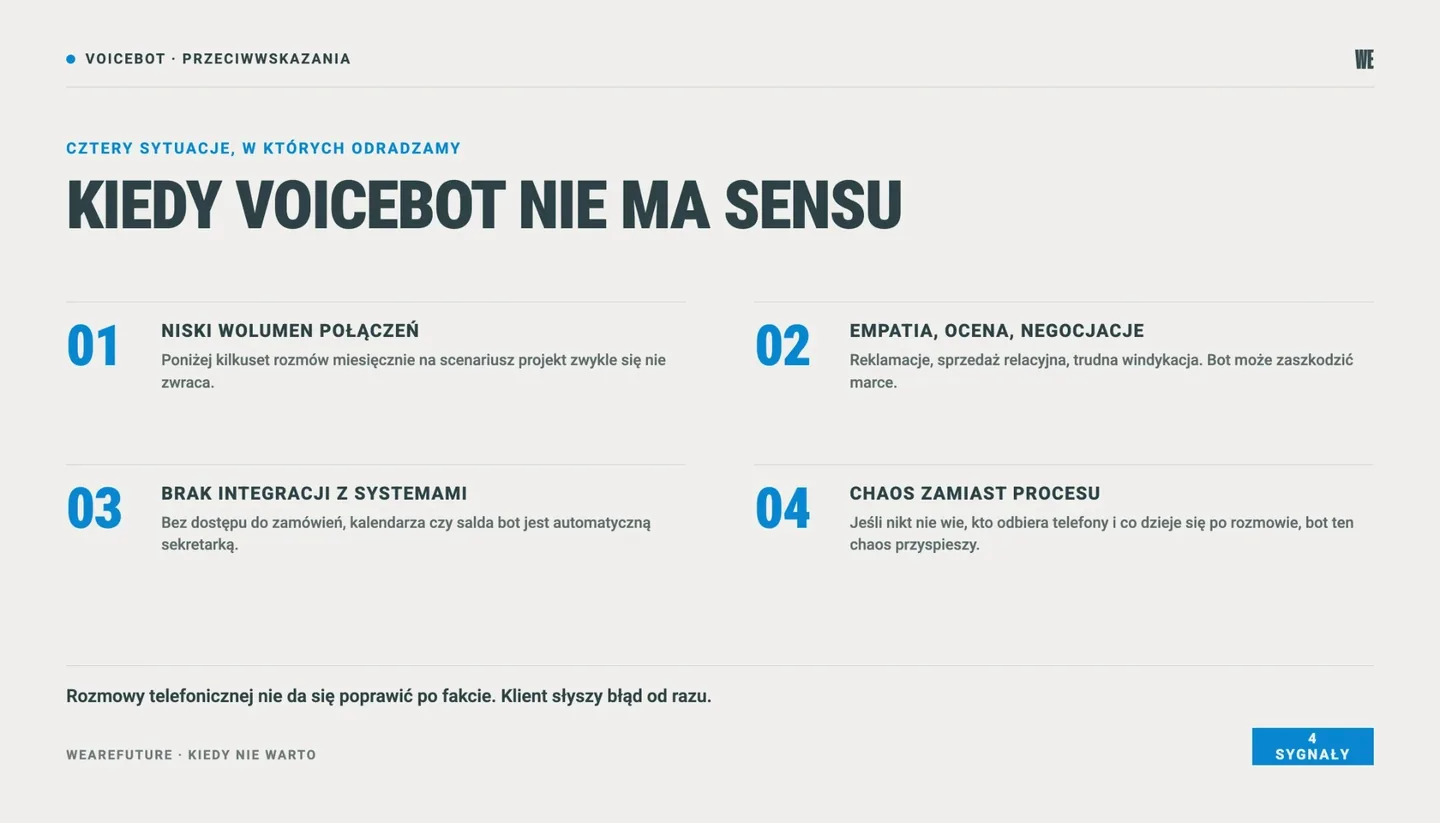
Low call volume. By our calculations, below a few hundred calls per month for one repetitive scenario the project usually doesn't pay back, because the cost of building and maintaining a scenario is largely fixed.
A process that requires empathy, judgment or negotiation. Complaints, relationship-based sales, difficult debt collection. Here the bot doesn't just fail, it can damage the brand.
No integration with systems. A bot without access to order status, the calendar or the account balance is an answering machine. If integration is impossible today, the project should be postponed, not cut down.
Chaos instead of a process. If today nobody knows who answers these calls and what happens after the call, a voicebot will speed up the chaos. In that case we start by organizing the process.
How we know when not to go ahead
In our implementation experience, an agent works when it enters a process that was organized beforehand. With a voicebot this dependency is even sharper, because a phone call can't be corrected after the fact. The customer hears the mistake immediately and draws conclusions about the company, not about the bot.
That is why in voice projects we start by deciding whether the project makes sense at all: choosing the scenario, calculating the cost of a call minute on a specific technology stack, assessing how ready the phone process is. This stage usually decides whether the whole thing succeeds.
We break down how to choose what to automate first in our guide to AI automation in the company. We described the difference between an agent and classic automation in a separate post.
Before you launch: what we agree before the start
Four things we settle in voice projects before the first call. Not every one applies to every implementation, but each is better settled on paper than along the way. These are our good practices, not a legal opinion: confirm the scope of obligations for a specific implementation with a lawyer.
Say it's a bot. EU rules on the transparency of AI systems, applicable since August 2, 2026, require that the caller knows they are talking to an AI system. It starts with a sentence at the beginning of the call, though the notice alone rarely covers it all. Machine-readable marking of synthetic voice is a separate issue, which for bots launched before August 2026 comes into play from December 2026. We set out the timeline of changes after the “omnibus” in our post on what the AI Act postponed. We recommend assuming that the obligation applies to the company that runs the bot under its own brand, not only to the technology provider, because that company usually plays this role.
Check who asks the questions in Poland. Since August 2026, the Polish Act on Artificial Intelligence Systems has been in force. It creates a national AI market surveillance authority: a commission with representatives of UOKiK (the competition and consumer protection office), KNF (the financial supervision authority), KRRiT (the broadcasting council) and UKE (the electronic communications office). According to the Ministry of Digital Affairs, the chair is to be appointed in October 2026 and the Commission will start operating in November; some of its powers towards companies, including handling notifications and individual opinions, start in autumn 2026. Until now Poland had no authority designated to handle complaints about AI systems as such; this is changing and has to be taken into account when designing the bot's opening message.
Recording: say why and for how long. At the start of the call we inform about the purpose, legal basis and retention period of the recording, in layers: a short notice plus a reference to the full clause. General data protection rules don't set a specific retention period for recordings, so the company sets and justifies it itself, unless sector rules bind it, as with investment services, where recordings of client calls are kept for several years. Watch out for a mental shortcut: the periods known from workplace video monitoring are a different regime and don't carry over to call recordings.
Marketing campaigns: consent first. We treat commercial information and direct marketing by phone as activities that require the recipient's prior consent, regardless of whether the call is made by a machine or a person. A breach is an act of unfair competition and exposes the company to a fine from the electronic communications regulator of up to 3% of revenue or up to one million zloty. Consent to marketing contact is separate from the legal basis for processing data, and we assume you need to take care of both. Service calls to your own customers, such as an appointment reminder or an order confirmation, are sometimes assessed differently from commercial information, but we recommend agreeing the line for a specific scenario with a lawyer before the campaign starts.
Step-by-step implementation and metrics you can trust
The order we recommend:
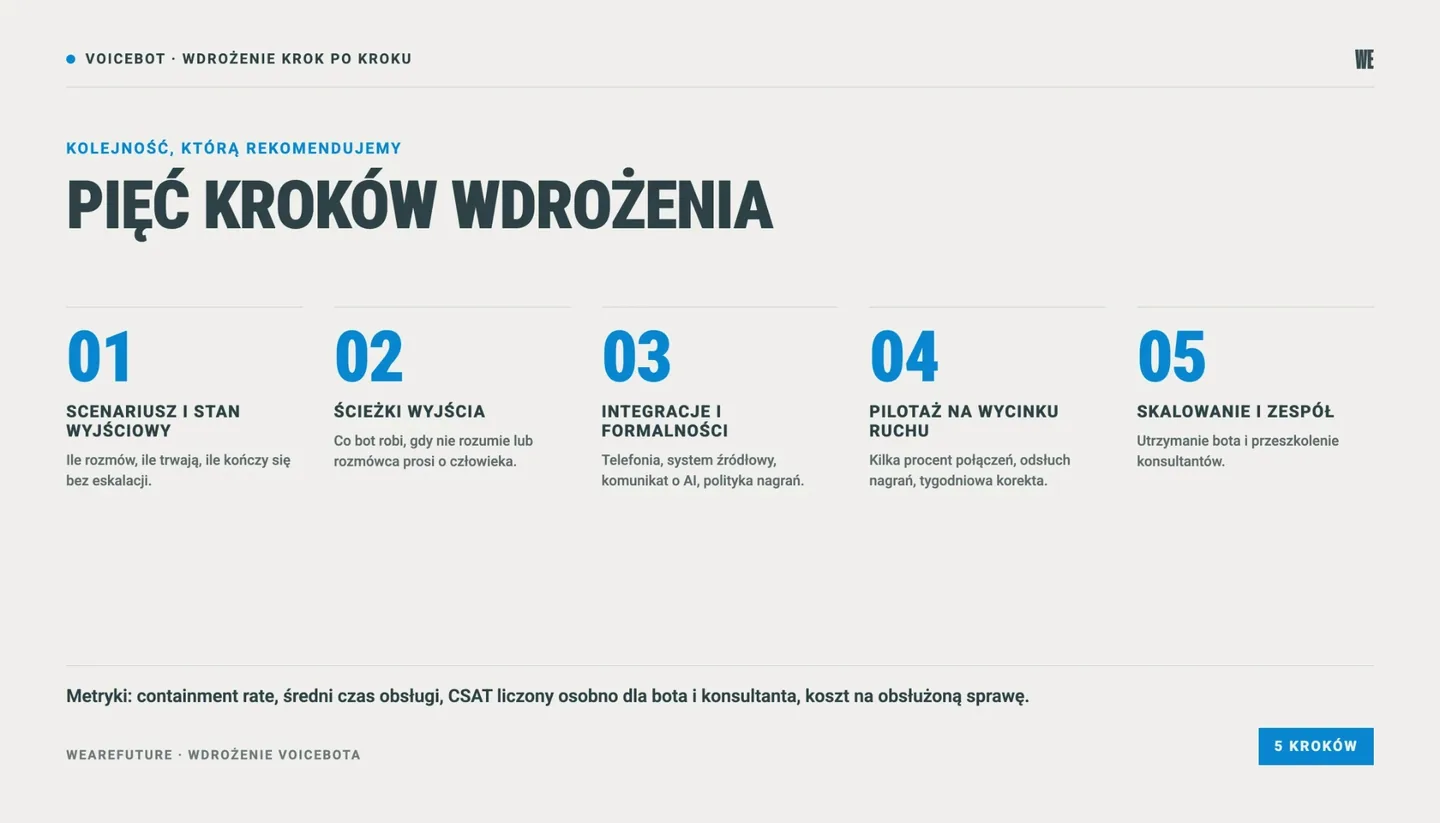
Choose one scenario and measure the baseline. How many of these calls there are, how long they take, how many of them end today without escalation. Without this number you can't say later whether the implementation succeeded.
Scenario and exit paths. What the bot does when it doesn't understand, when the caller asks for a person, when the system doesn't respond. Fallback paths are designed together with the scenario, not after the first complaints.
Integrations and the formal layer. Telephony, the source system, the AI notice, the recording policy.
Pilot on a slice of traffic. A few percent of calls, with listening to recordings and weekly scenario corrections.
Scaling, maintenance and training the service team. The bot matures over the first months, and agents need to know what they receive when a call is handed over. This is where training for teams comes in.
Metrics that make sense: containment rate (the share of calls completed in the automated channel without handover to a person), average handling time, CSAT after a bot conversation measured separately from CSAT after an agent conversation and cost per resolved case, not per minute. The reference point is the cost of the same case handled by a person, calculated for your scenario. The only reliable reference point is your own measurement from before the implementation, made the same way as the measurement after.
Callers are also more cautious than most business cases assume. The Armatis Customer Experience Index, a SW Research survey from June 2025 on a sample of 817 people (as reported in a summary of the survey), shows that 8.1% of respondents fully trust bots in customer service, and 67.9% would rather wait in a queue for an agent than be served immediately by a bot, while another 39.5% trust bots only with simple, routine matters. Satisfaction is growing, though slowly. The rule is simple: a voicebot makes sense where the customer saves time and the way out to a person stays open.
For context: in the Human Capital Study (BKL) carried out for PARP (the Polish Agency for Enterprise Development) on a sample of 1,822 employers from the twelve sectors with the highest potential for AI adoption, 23% of companies report using AI in business processes. A voicebot is still a decision ahead of the market, as long as there is a calculated process behind it.
If you want to check whether your phone process is fit for automation and what a call minute would cost in your scenario, book a call: 30 minutes, no commitment. We do AI implementations that we close with a measurement, not just a launch.
Frequently asked questions about voicebots for business
How much does a voicebot cost?
Two separate items. The variable cost is roughly USD 0.10-0.25 net per minute of an inbound call in Polish and USD 0.16-0.46 net per minute of an outbound campaign to mobile numbers, after adding telephony and the language model to the voice provider's rate; an orchestration platform adds USD 0.05-0.07. The project cost, by WeAreFuture estimates, is PLN 15-40k net for a pilot of one scenario and PLN 60-150k net for a production implementation with integrations. As of August 2026: confirm the final amount with the vendor.
Does a voicebot speak natural Polish?
Yes, at a level where the caller doesn't hang up. Most of the major speech synthesis engines on the market support Polish today. Google has the most dedicated Polish voice variants; in ElevenLabs every voice speaks Polish, because the models are multilingual, and Azure wins where the company already sits in the Microsoft ecosystem. The exception is Deepgram: it recognizes Polish but doesn't synthesize it.
How long does it take to implement a voicebot?
Based on WeAreFuture experience, a pilot of one scenario without system integrations usually takes 2-4 weeks, and a production implementation with telephony and source system integration 6-12 weeks. Most of the time goes not into the technology, but into organizing the process and designing the exit paths to an agent.
Do customers accept talking to a bot?
Cautiously. In the Armatis and SW Research survey from June 2025, on a sample of 817 people, as reported in a summary of the survey: 8.1% of respondents said they fully trust bots in customer service, 67.9% would rather wait in a queue for an agent than be served immediately by a bot, and 39.5% trust them only with simple, routine matters. Acceptance grows where the bot answers immediately, handles a simple matter and passes a harder one on without resistance. We advise against hiding that the caller is talking to AI, regardless of the scale of the implementation: EU rules on AI transparency, applicable since August 2, 2026, are built around the caller knowing it.
Recording voicebot calls: what to keep in mind
At the start of the call we inform about the purpose, legal basis and retention period of the recording, and that the call is handled by an AI system. General data protection rules don't set a specific retention period for recordings: the company sets and justifies it itself, unless sector rules bind it. Separate consent is needed for marketing contact if the bot calls for that purpose. Settle the scope of obligations for a specific implementation with a lawyer before the start.
Sources
ElevenLabs - ElevenAgents pricing (per-minute rate, concurrency limits, separate billing for the model and telephony): elevenlabs.io/pricing/agents
ElevenLabs - models and their latency: elevenlabs.io/docs/overview/models
ElevenLabs - voice agent latency optimization (P50 and P95 targets): elevenlabs.io/blog/voice-agent-latency-optimization
ElevenLabs - data residency and zero retention mode: elevenlabs.io/docs/overview/administration/data-residency
Microsoft - language support and neural voices in Azure AI Speech: learn.microsoft.com
Microsoft - Azure AI Speech pricing: azure.microsoft.com/en-us/pricing/details/speech
Google Cloud - list of voices and types: docs.cloud.google.com
Google Cloud - Text-to-Speech pricing: cloud.google.com/text-to-speech/pricing
Deepgram - supported languages in TTS models: developers.deepgram.com/docs/tts-models
Deepgram - pricing: deepgram.com/pricing
Twilio - voice call pricing for Poland: twilio.com/en-us/voice/pricing/pl
Twilio - ConversationRelay pricing: twilio.com/en-us/products/conversational-ai/pricing
Vapi - platform pricing: vapi.ai/pricing
Retell AI - platform pricing: retellai.com/pricing
European Commission - guidelines on transparency obligations for AI systems (July 20, 2026): digital-strategy.ec.europa.eu
Ministry of Digital Affairs (Poland) - what changed in AI rules in August 2026 (in Polish): gov.pl/web/cyfryzacja
Ministry of Digital Affairs (Poland) - the Polish Act on AI systems and the supervisory authority (in Polish): gov.pl/web/cyfryzacja
Armatis Customer Experience Index, SW Research survey, June 2025, sample of 817 people (as reported in a summary of the survey, in Polish): swresearch.pl
PARP, “Artificial intelligence in companies: readiness for adoption, competences and needs. BKL research report”, Warsaw 2026 (in Polish); quantitative survey June-September 2025, sample of 1,822 employers: parp.gov.pl
Project cost ranges - WeAreFuture estimate, 2026
All amounts in this article are net. Prices as of August 2026. Regulations checked: September 1, 2026. Voice tool prices change more often than typical SaaS: confirm the final amount with the vendor on the day of purchase. This post is not a legal opinion.
