
The biggest AI deployment in your company has already happened. Nobody approved it, nobody calculated its risk, and it is most likely not in any register. It is called shadow AI.
Your people are already pasting contract excerpts, customer data and company code into personal ChatGPT, Gemini or Claude accounts, because it helps them do their jobs. This is not sabotage, it is initiative. The problem is that in 2026 this initiative becomes a matter for the desk of the board and the legal department: further AI Act provisions apply from August 2, and the Polish act on artificial intelligence systems has been in force since August 11.
WeAreFuture is a Polish AI advisory and implementation firm based in Warsaw. We guide mid-sized and large organizations through AI transformation, from diagnosis to implementation. This article is about how to get shadow AI under control without killing the productivity your people have already built, and about what the AI Act means for a company in the second half of 2026. We write from an advisory perspective, not a legal one (this is not legal advice), and we focus on what you can do.
What shadow AI is
Shadow AI is the uncontrolled use of AI tools and the processing of company data in them outside the organization’s knowledge and policy. It is the equivalent of “shadow IT” from a decade ago, only faster and much harder to detect, because it requires no installation and no approval from the IT department. A browser and a personal account are enough.
Why does it appear? For three very rational (from the employee’s perspective) reasons. First, the official tool either does not exist or is inconvenient. Second, AI shortens the work, so people reach for what works, here and now. Third, there is no clear policy, so the default “nobody forbade it” applies. This is not malice or ignorance, it is the natural reaction of people who want to work faster.
It usually looks innocent. A salesperson pastes the price list and customer data into a personal chat to prepare a quote in five minutes. An analyst uploads a fragment of a database to find a pattern faster. A lawyer summarizes a contract, marketing generates graphics and copy in one tool after another, and the IT team uses coding assistants. Each of these on its own is small and sensible. Together they form a picture in which company knowledge flows outside every day in a dozen places at once, and nobody sees it or counts it.
The scale of the phenomenon: what the data says
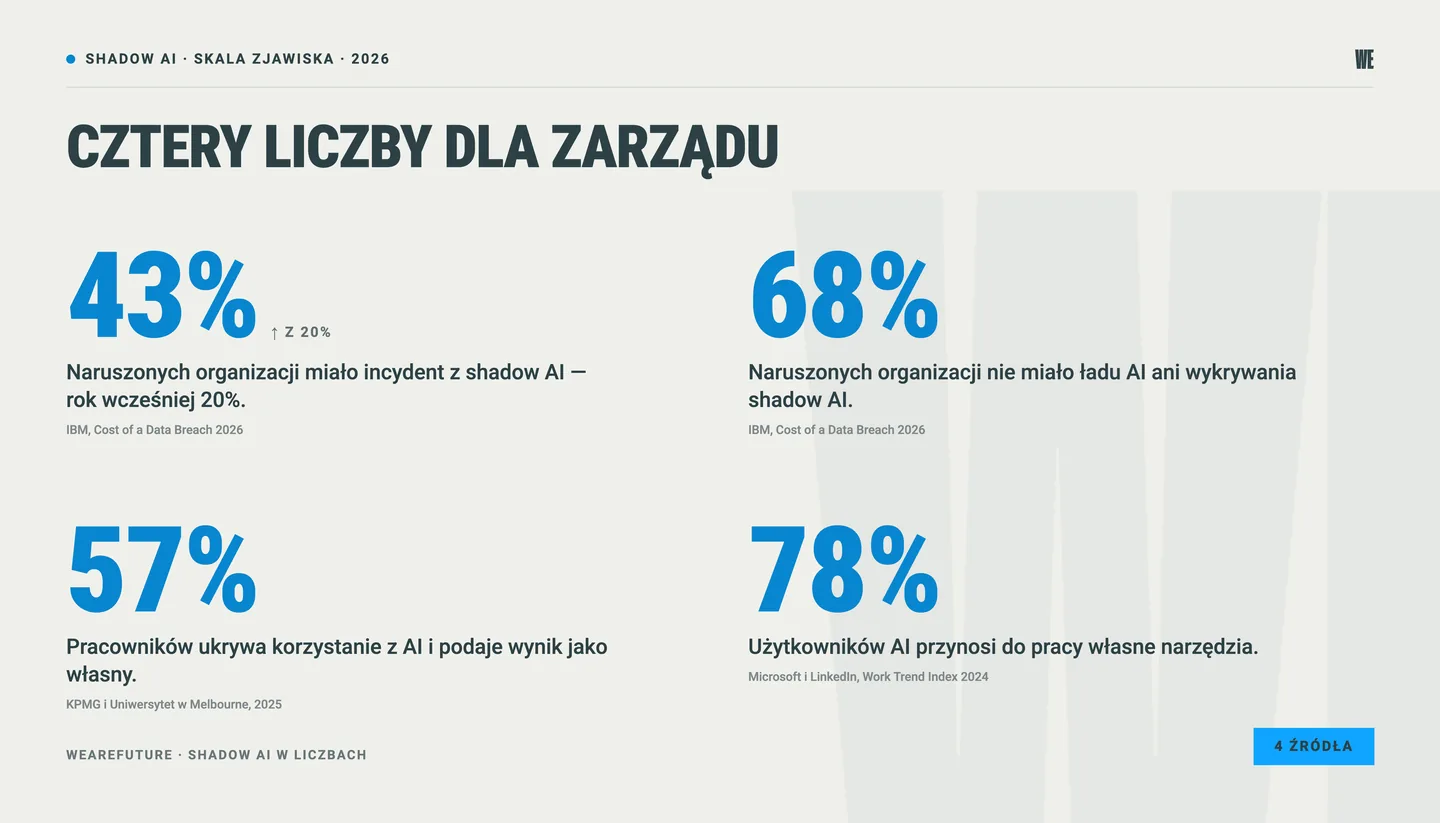
Shadow AI is the norm in most organizations, not the exception. Four numbers that are enough for a slide for the board:
Number | What it shows | Source |
|---|---|---|
43% | of breached organizations had an incident involving shadow AI, meaning unauthorized use of AI by employees. A year earlier it was 20%, so the phenomenon doubled within a year | IBM, Cost of a Data Breach Report 2026 |
68% | of breached organizations had no AI governance and no mechanisms to detect shadow AI. Only 38% required IT approval before deploying AI, a year earlier 45%. Oversight is not growing, it is receding | IBM, Cost of a Data Breach Report 2026 |
57% | of employees hide their use of AI and present the output as their own. 48% admit to using AI against company policy | KPMG and the University of Melbourne, a study of 48,000 people in 47 countries, 2025 |
78% | of AI users at work bring their own tools to it, from outside the company stack | Microsoft and LinkedIn, Work Trend Index 2024 |
The conclusion is simple: the question is not “do we have shadow AI”, but “how much do we know about it and what are we doing about it”. If you think your company is an exception, you are most likely among the 68% that have no way to check.
In 2026 the phenomenon is accelerating, not slowing down. Models are getting better and cheaper, agentic tools and coding assistants are appearing, and AI is entering the programs teams already use every day. The more useful AI becomes, the stronger the temptation to reach for it “quickly”, without asking. That is why shadow AI is not a passing fad you can wait out. It is a lasting state that has to be managed.
Why it is a problem and not IT paranoia
Shadow AI has four concrete costs that sooner or later land on the board’s desk.
Data leaks and loss of IP. Customer data, contract excerpts, code, plans and trade secrets end up in external services. Depending on the tool and its settings, content may be stored or used for further model development, and you lose control and the trail of what went where. Context once disclosed cannot be taken back. According to the IBM Cost of a Data Breach 2026 report, breaches involving shadow AI cost an average of USD 5.39 million, and 49% of them ended in loss or compromise of data.
Compliance: GDPR and the AI Act. If you do not know what data goes to which tools and why, you cannot demonstrate compliance. GDPR applies independently of the AI Act and overlaps with exactly the same phenomenon. No visibility means no compliance, full stop. The consequences are not theoretical: IBM reports that in about one in five shadow AI incidents the organization paid a regulatory fine.
Quality and wrong decisions. Uncontrolled outputs, with no verification and no shared standards, mean hallucinations that end up in quotes, reports and sometimes straight with the customer. Without shared context everyone gets a different quality, and the company has no control over it.
Risk without economies of scale. This is the most insidious cost. Since people use AI anyway, the company bears all the risk but gets no economies of scale: no shared standards, no shared context and no skills, which we wrote about in the piece on context files and skills. You pay a “risk tax” and get nothing back.
The AI Act in a nutshell for the board (as of August 2026)
This is not legal advice, it is an advisory summary: what the AI Act means for a company that uses AI. Confirm the specific classification and obligations for your cases with a lawyer, and a general picture of the company’s readiness, including rules and risk, is given by our AI Check (20 questions, about 7 minutes). It is an assessment of AI maturity, not a compliance audit.
The EU AI Act (Regulation 2024/1689) has been in force since August 2024 and is being implemented in stages. The last 12 months brought two big changes: a reform at EU level and the entry into force of the Polish implementing act. The key points from the perspective of a typical company:
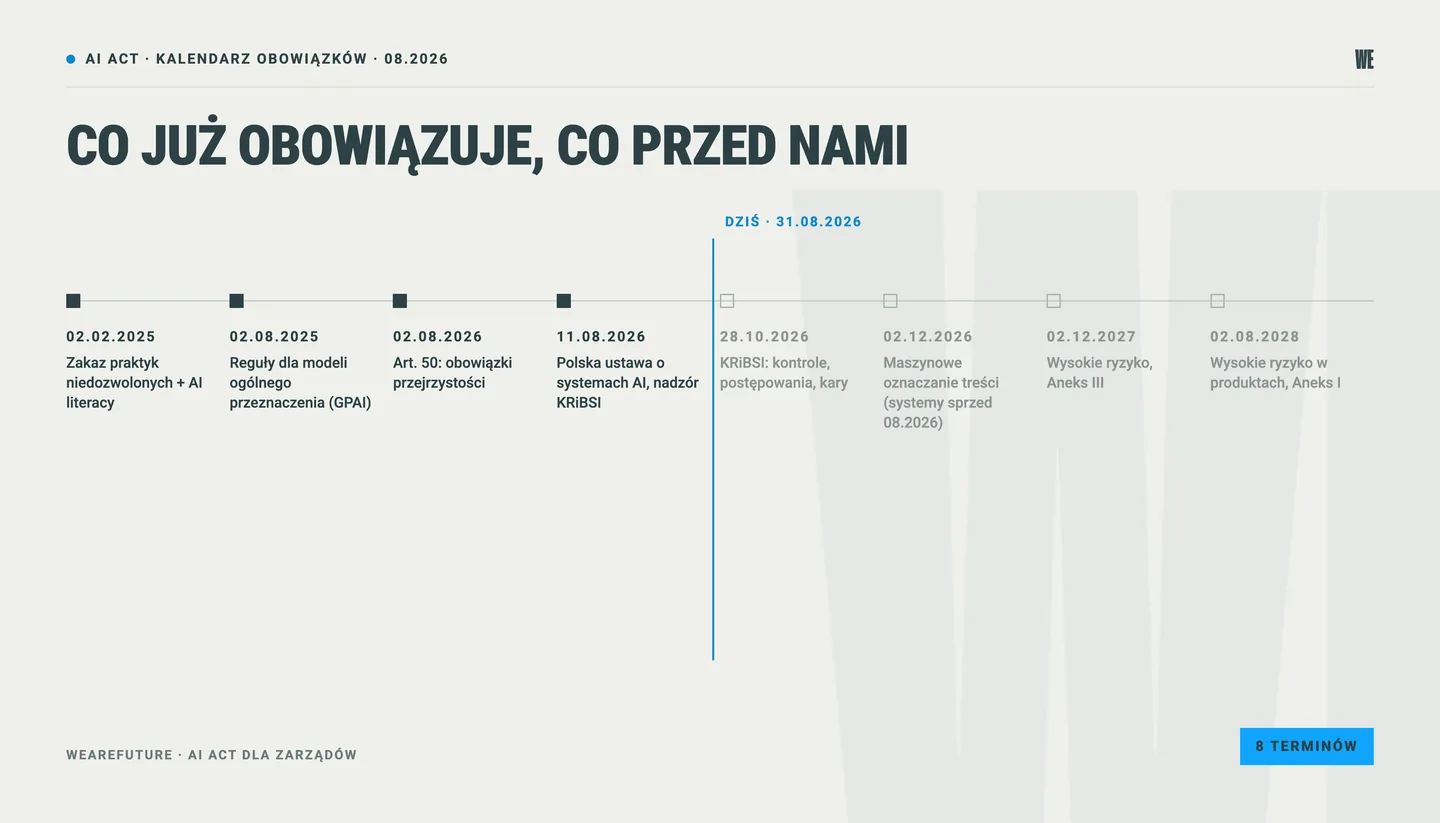
What has applied for a while. Since February 2, 2025 the ban on prohibited practices and the AI competence obligation (so-called AI literacy) have applied. Since August 2, 2025 the rules for general-purpose models (GPAI) apply.
What came into effect on August 2, 2026. Article 50 started to apply, meaning the transparency obligations: informing the user that they are talking to an AI system, labeling synthetically generated content, disclosing deepfakes. This affects practically every company that has a chatbot on its website or generates marketing content with AI. This stage is already underway, it is not ahead of us.
The Digital Omnibus is already law. Regulation (EU) 2026/1744 was published in the Official Journal of the EU on July 24, 2026 and entered into force on July 27, 2026. It is no longer a draft or a political agreement, it is a binding act.
High-risk systems: more time. The Omnibus moved the application of obligations for high-risk systems from Annex III to December 2, 2027, and for AI embedded in regulated products (Annex I) to August 2, 2028. The risk-based architecture itself (four levels, the GPAI track, conformity assessment) has not changed.
Content labeling: a transition period until December 2, 2026. Providers of systems that generate synthetic content that were placed on the market before August 2, 2026 have until December 2, 2026 to implement machine-readable labeling. Note: this is a narrow exception for one paragraph of Article 50, not a postponement of the whole transparency obligations.
AI literacy: the obligation was rewritten, not abolished. The Omnibus changed the wording of Article 4. Previously providers and deployers of AI were to “ensure a sufficient level” of AI competence. Now they are to “take measures to support the development” of these competences, with an explicit caveat that they do not have to guarantee a specific level in a specific person. The duty of care remains, the burden of proof has eased. For a company this changes little: you still have to be able to show what you did.
The penalties are high. Up to EUR 35 million or 7% of worldwide turnover for prohibited practices and up to EUR 15 million or 3% of turnover for violations concerning high-risk systems. The regulation also has extraterritorial reach, so it applies to non-EU companies operating on the EU market too.
There is a trap here, though. The postponement of deadlines for high-risk systems is sometimes read as “we have more time, we can let it go”. That is a mistake, and we wrote about it at more length when the omnibus was still a draft: the AI Act delayed by 18 months and what it means for companies. The hardest and slowest part of compliance is not filling in a documentation template but establishing which AI systems you use at all, for what, and with what risk. Shadow AI means you simply do not have that map, and without it you cannot build any compliance, regardless of when specific deadlines fall.
On top of that comes the AI competence obligation, which applies to practically every company today. It connects directly to the topic of adoption and to AI training for companies, because a policy whose point the team does not understand remains a dead document.
The Polish AI systems act and KRiBSI: what changed in August 2026
Poland now has its own implementing act for the AI Act. The Act on Artificial Intelligence Systems was published in the Journal of Laws on July 27, 2026, and its main part entered into force on August 11, 2026. This changes the situation in one important respect: the AI Act has stopped being an abstraction with no addressee in Poland.
The AI market surveillance authority is the Commission for the Development and Safety of Artificial Intelligence (KRiBSI), a new body administratively supported by the Ministry of Digital Affairs, with representatives of, among others, the President of UOKiK (the competition and consumer protection office), KNF (the financial supervision authority), KRRiT (the broadcasting council) and the President of UKE (the electronic communications office). KRiBSI conducts proceedings in cases of violations, issues opinions and interpretations, runs regulatory sandboxes and educational activity.
Three dates worth having in your calendar:
August 11, 2026 - the main part of the act applies.
October 28, 2026 - the provisions on inspections, proceedings and penalties start to apply. This is the moment from which oversight stops being declarative.
October and November 2026 - appointment of the chair and completion of the Commission’s membership, meaning the actual start of its work.
For a company this means one thing: the window for calmly putting the topic in order closes this quarter, not in 2027. After October 28 the question “which AI systems do you use and who is responsible for them” can come from an authority, not only from a customer in a procurement process. A company that has a register, an owner and a policy answers within a week. A company with only shadow AI does not answer at all.
Who in the company is responsible for shadow AI
The most common answer is: nobody. Shadow AI hangs in a vacuum between departments. IT says it is a business topic, the business says it is an IT topic, the legal department finds out last, and the board assumes “someone has it covered”. As a result nobody has it covered, and that is exactly why the phenomenon grows. IBM data confirms it: only 19% of organizations report coordination between the teams responsible for AI governance and for security.
Oversight of this risk and naming the owner of the topic are among the things that the board cannot delegate downward.
Getting it in order starts with one decision: naming the owner of the topic. The setup that works best is one in which one person is responsible for the topic, supported by security or IT (on data and tools), the legal or compliance department (on GDPR and the AI Act) and the owner of the AI topic (on implementations and adoption), under board sponsorship. This is not about setting up a committee that meets once a quarter. It is about a person who is responsible for making sure the company knows what it uses and has a safe alternative.
Without this step every next one (policy, training, register) will hang in the same vacuum as the phenomenon itself.
What NOT to do: a ban does not work
The first reflex of many boards is “let’s ban AI”. This is the worst possible reaction and it makes the situation worse for three reasons at once. Shadow AI goes even deeper, onto personal phones, accounts and devices, so you lose what visibility you had left. You kill the productivity people have already built. And you send a signal that the company does not understand a tool the rest of the market uses.
The numbers say the same. If 48% of employees admit to using AI against company policy and 57% hide their use of it, then another ban does not change the behavior, only the level of concealment.
That is prohibition, not governance. A good analogy is health and safety rules: you do not ban work with machines, you set how to do it safely. A ban does not remove the phenomenon, it pushes it into the shadows, where it is even more dangerous. The goal is not to eliminate AI but to bring it out of the shadows into the light.
How to get shadow AI under control: five steps
Getting shadow AI in order is not a one-off action but five steps worth taking in this order.
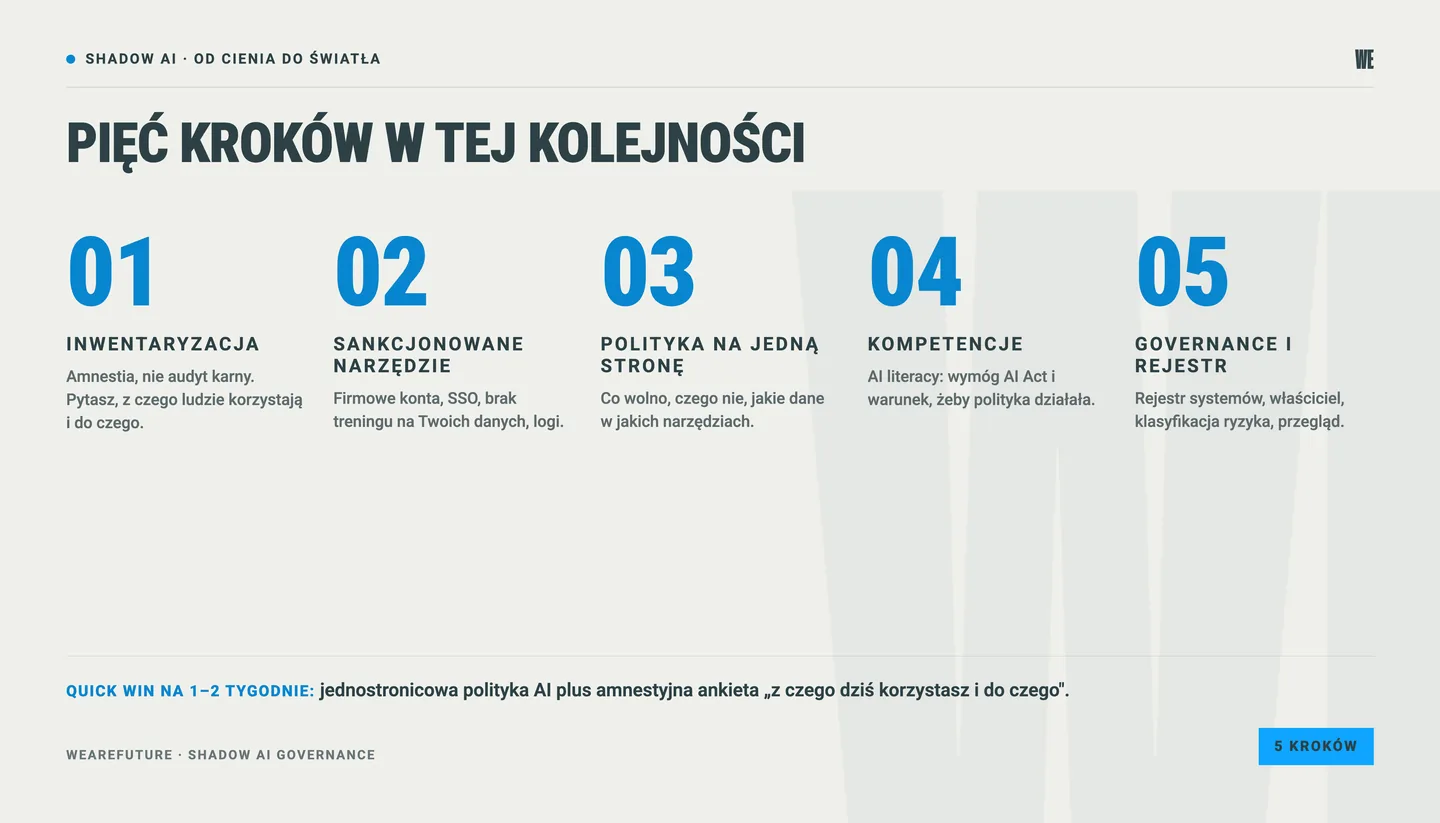
1. Take inventory, without a witch hunt. Ask directly what people use and for what. This should be an amnesty, not a punitive audit, because otherwise everyone will hide and you will be left with a false picture. The goal is a map of actual use and needs, not a list of the guilty.
2. Provide a sanctioned, convenient alternative. People use shadow AI because it works. Make a safe company tool available: access through company accounts and single sign-on (SSO), settings that do not use data for model training, and for sensitive data a sandbox or an on-premise environment (see: AI implementations). Company and business plans of the main AI tools today give administrative controls (access management, no training on your data, logs) that by definition do not exist on a personal, free account. The rule is simple: if the official tool is better and more convenient than the personal one, shadow AI disappears on its own, without any ban.
3. Write a short AI use policy. What is allowed, what is not, which data in which tools. One page understandable to every employee, not a thirty-page set of rules nobody will read. A policy that cannot be applied is just a fig leaf for the board.
4. Build competence (AI literacy). It is both a requirement of the AI Act and a condition for the policy to make sense. People must understand why certain data cannot go into a personal chat and how to use AI responsibly. This is where AI adoption programs come in directly, because an aware team is a cheaper and more effective safeguard than any ban.
5. Set up governance and visibility. A register of the AI systems in use, an assigned owner, risk classification and periodic review. This is exactly the same discipline as with shared context and skills: a shared resource under control, not a wild west. A register of AI systems is, in addition, the first step toward AI Act compliance and the first thing a supervisory authority will ask for.
A quick win in one to two weeks: a one-page AI policy plus a short, amnesty-style survey “what do you use today and for what”. You immediately get two things: a map of actual use and a clear signal in the organization that the company takes the topic seriously instead of pretending the problem does not exist.
Three questions the board should be able to ask itself tomorrow morning:
Do we know which AI tools our people use and for what? If not, we have neither control nor compliance.
Do we have a one-page AI use policy, and does anyone outside the legal department know it?
Do we give people a safe, convenient alternative, or only bans? Because if only bans, it means we chose ignorance over control.
If the answer to any of these questions is “no”, you already know where to start.
Shadow AI is a symptom, not the disease
Shadow AI appears exactly where there is demand for AI and no organized implementation. It is a signal that people are already ready and the organization has not caught up yet.
That is why it is first of all not a problem to punish but a free needs study. Shadow AI shows in black and white where in your company AI helps and where it is worth implementing first. Instead of putting it out, turn this shadow into a prioritized backlog of implementations.
Governance around shadow AI is part of the foundation on which mature use of AI stands. We set up governance and adoption in stages, process by process, in our collaboration model, and the rules for working with data become part of the AI Engine, a shared company context used by people and agents. This whole area is one dimension of the broader AI transformation in a company. The same logic as with AI implementations from chaos to order: order first, then scale.
Companies that do this first gain twice: they take the risk off themselves and at the same time learn where AI gives them the biggest payoff. It is a rare case in which reducing risk and building an advantage are exactly the same work.
If you want to turn shadow AI from a hidden risk into an organized advantage, that is where we start working together. A starting point is AI Check: 20 questions, about 7 minutes, full results without email. It is an assessment of AI maturity, not a compliance audit. We put the rest in order together with your team in our collaboration model, in stages, process by process.
Frequently asked questions (FAQ)
What is shadow AI?
It is the uncontrolled use of AI tools and the processing of company data in them outside the organization’s official knowledge and policy, for example pasting customer data or contract excerpts into personal ChatGPT, Gemini or Claude accounts. It is the equivalent of the old “shadow IT”, only faster and harder to detect, because a browser is enough. According to the IBM Cost of a Data Breach 2026 report, incidents involving shadow AI affected 43% of breached organizations, compared with 20% a year earlier.
Is shadow AI illegal?
Using AI tools is not illegal in itself. The problem is uncontrolled data processing, which may violate GDPR, obligations under the AI Act, customer contracts or trade secrets. The risk is therefore not in “using AI” but in the lack of control over what data goes where. This is not legal advice, and a specific assessment is worth confirming with a lawyer.
Should we simply ban ChatGPT and other AI tools?
No. A ban pushes shadow AI even deeper (personal phones and accounts), removes what visibility is left and kills productivity. A study by KPMG and the University of Melbourne shows that 48% of employees use AI against company policy anyway, and 57% hide their use. It is more effective to provide a sanctioned, convenient alternative, write a short policy and train people. If the official tool is better than the personal one, shadow AI disappears on its own.
What from the AI Act applies in August 2026?
The AI Act applies in stages. Since February 2, 2025 the ban on prohibited practices and the AI competence obligation have applied, since August 2, 2025 the rules for general-purpose models (GPAI), and since August 2, 2026 the transparency obligations of Article 50, including informing people about interaction with AI and labeling synthetically generated content. The Digital Omnibus, that is Regulation (EU) 2026/1744, entered into force on July 27, 2026 and moved the obligations for high-risk systems to December 2, 2027 (Annex III) and August 2, 2028 (regulated products, Annex I). For systems generating synthetic content placed on the market before August 2, 2026, the obligation of machine-readable labeling applies from December 2, 2026.
Is the Polish act on AI systems already in force?
Yes. The Act on Artificial Intelligence Systems was published in the Journal of Laws on July 27, 2026, and its main part entered into force on August 11, 2026. The AI market surveillance authority in Poland is the Commission for the Development and Safety of Artificial Intelligence (KRiBSI). The provisions on inspections, proceedings and penalties start to apply on October 28, 2026, and the Commission’s membership is to be completed in October and November 2026.
Is using ChatGPT a “high-risk system” within the meaning of the AI Act?
Ordinary, everyday use of an AI assistant is usually not in itself a high-risk use. The classification depends on the specific use, not on the tool itself. Regardless of that, GDPR, the transparency obligations of Article 50 and AI competence apply to you, and above all you must know what AI is used for in your company and with what data. This is not legal advice.
What are the penalties for non-compliance with the AI Act?
The penalties are high: up to EUR 35 million or 7% of worldwide turnover for prohibited practices and up to EUR 15 million or 3% of turnover for violations concerning high-risk systems. The regulation has extraterritorial reach, so it also covers non-EU companies operating on the EU market. Beyond AI Act sanctions, GDPR and other sector-specific rules also come into play. According to IBM, in about one in five incidents involving shadow AI the organization paid a regulatory fine.
How do you write an AI use policy?
Start with one page understandable to everyone: which tools are allowed and which are not, which data may be processed in them, what the sanctioned alternatives are for sensitive data, and who owns the topic and whom to ask questions. The policy has to be combined with training, because a document whose point is not understood does not change behavior.
Where do we start?
With an amnesty-style inventory (“what do we use today and for what”), making a safe, convenient tool available, writing a one-page policy, training the team and setting up a simple register of the AI systems in use with an owner. These are five steps that turn the shadow into an organized, measurable area within a few weeks.
What data should not go into public AI tools?
Personal data of customers and employees, trade secrets, protected source code, data covered by confidentiality agreements and non-public financial data. A simple heuristic for the team: if you would not email a given piece of content to a random person outside the company, do not paste it into a public, free chat. For such data, use sanctioned tools with administrative control or an on-premise environment.
Sources
IBM, Cost of a Data Breach Report 2026 (a study of 602 organizations, breaches from March 2025 to February 2026).
KPMG and the University of Melbourne, Trust, attitudes and use of artificial intelligence: A global study 2025 (48,000 respondents in 47 countries).
Microsoft and LinkedIn, Work Trend Index 2024: AI at Work Is Here. Now Comes the Hard Part (31,000 knowledge workers in 31 countries).
Regulation (EU) 2024/1689 (AI Act), EUR-Lex.
European Commission, AI Omnibus enters into force, July 27, 2026.
Ministry of Digital Affairs, The AI Systems Act: safe development of artificial intelligence in Poland.
