
Two companies give their AI assistant exactly the same prompt. One gets an answer that has to be rewritten from scratch. The other gets material ready to send. The model is the same. Context makes the difference.
In 2026 practically everyone has access to the best models, and it costs pennies. That means the model itself has stopped being an advantage, because your competitor uses exactly the same one. The real lever is elsewhere: in AI context, that is, in how well you can describe your company to the model, and whether you do it once, in a reusable way, or from scratch every time.
This article is about two things that decide whether AI in a company actually works: context files and skills. I will show how to build them on three levels (person, team and the whole organization) and, just as important, how to manage them so that shared context does not turn into another source of chaos. I write from an advisory perspective, not a technical one.
The model is a commodity. Context is the advantage
Over the last two years companies raced for access to “the best model.” That race is over: according to the Stanford AI Index, the cost of inference at the GPT-3.5 level fell more than 280-fold in two years (2022-2024), and top-tier models are today available to everyone for a fraction of the former cost. If you and your competitor have the same technology, it is not what sets you apart.
What sets you apart is what the model gets as input. The same model, fed a precise description of your company, processes and standards, produces a result that a competitor with a generic prompt cannot reproduce. Context is like the soil in which AI works: nothing will grow in barren soil, even if the tool is the best.
Context is one of the seven layers of the harness, that is, the shell around the model. Why it is the shell, not the choice of model, that decides the outcome of most implementations, we lay out in the text harness or model AI.
There is a catch, though. In most companies this valuable context exists, but it lives in the wrong place: in the heads and private chats of a few “power users.” One or two people have learned to talk to AI really well, because every time they manually paste in the right background. The rest of the organization gets weak results and quickly loses enthusiasm. The scale of this gap shows in the data: according to Eurostat (December 2025), 20% of companies in the EU use AI, and in Poland only 8.4%. This is exactly the same pattern we described in AI implementations from chaos to order: what decides the value is not the purchase of a tool, but whether knowledge is organized and available to everyone.
That same private conversation with a model has a flip side: company data that leaves the organization’s control. We write about it in the text on shadow AI and the AI Act.
Context files and skills are a way to take this knowledge out of heads and chats and turn it into a shared, lasting company asset.
What a context file is (and how it differs from a prompt)
A prompt is a one-off instruction. You write it, you get an answer, and it disappears. In the next conversation you start from zero.
A context file is a lasting, reusable document that tells AI who you are, how you work, what your company does, which terms you use and what to avoid. You attach it once, and it works in the background in every conversation. The simplest analogy: onboarding a new employee. You do not explain everything from scratch with every task, you give them introductory materials and a company “handbook.” A context file is that kind of onboarding for AI, except that once written it works indefinitely and for everyone who uses it.
What is usually in it:
Role and goal - who the recipient of the output is and why it is being created.
Style and tone - how we write, how we speak to the client, what we do not do.
Definitions and glossary - terms specific to the company and the industry, so that AI does not guess.
Rules and constraints - what is not allowed, which phrasings to avoid, what the compliance requirements are.
Examples of a good result - one or two models that show “this is what we mean” better than a page of description.
The key difference from a prompt is that context accumulates and scales. A good prompt helps once, one person. A good context file helps many times, everyone who uses it, and the longer you use it, the more it pays off.
The mechanism depends on the tool (projects and instructions in assistants, custom configurations in Copilot, dedicated contexts in agentic solutions), but the idea itself does not depend on the vendor. You do not buy a “context file,” you build it, and that is exactly the part that cannot be copied from a competitor.
Three levels of context: person, team, organization
The biggest mistake is to think of context as one document. In a mature organization, context is arranged in three levels that overlay each other.
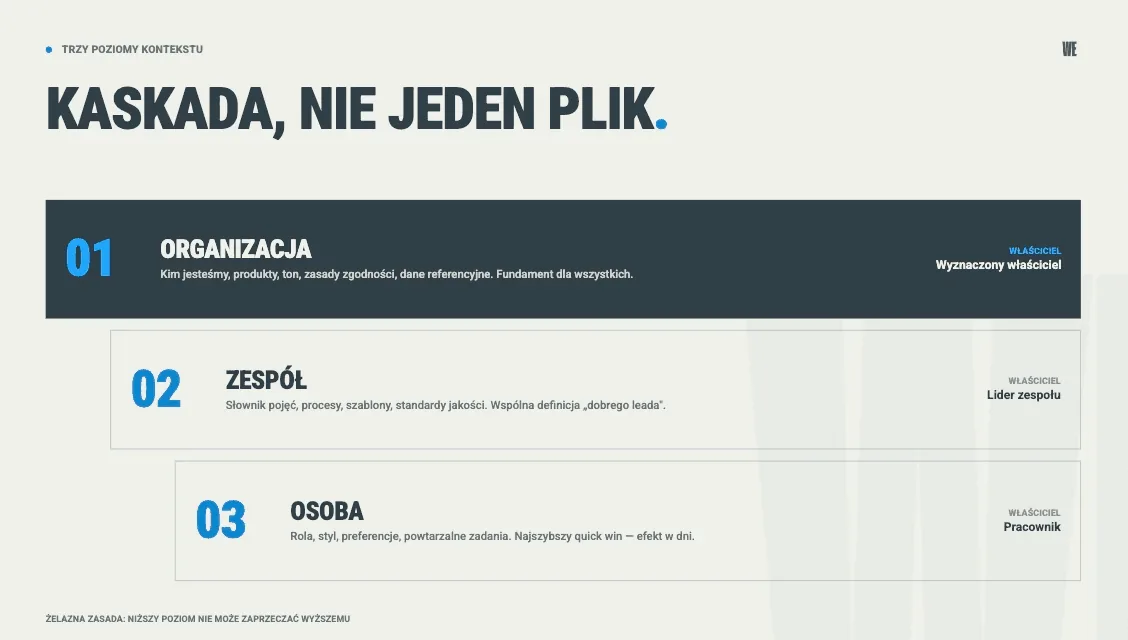
Personal level
The individual context of a single person: their role, style, preferences, recurring tasks. A salesperson describes how they write proposals and for which clients; an analyst, what their standard report looks like. It is the fastest quick win, because the effect is visible right away and needs nobody’s permission. The owner is the employee.
Team level
Shared team context: a glossary of terms, a description of processes, templates, quality standards. It solves a very specific problem that appears when several people start using AI at once: everyone explains it in their own way and everyone gets different results. A shared team file makes five people work on the same definition of a “good lead” or a “complete proposal.” The owner is the team lead.
Organization level
The context of the whole company: who we are, what we do, our products, values, tone of communication, compliance rules, reference data. This is the foundation from which all teams and people inherit. Written once and well, it stops being something everyone discovers anew. Who should manage it is a question of governance, which we come back to below.
Level | What it contains | Owner | Example |
|---|---|---|---|
Personal | role, style, preferences, recurring tasks | employee | “how I write sales emails” |
Team | glossary, processes, templates, quality standards | team lead | “definitions and stages of our sales process” |
Organization | company description, products, tone, compliance rules, reference data | a designated owner (see: governance) | “who the company is, how we speak to the client, what is not allowed” |
These layers cascade: the organization is the base, the team refines it, the person adds their own individual polish. One iron rule applies: a lower level cannot contradict a higher one. A personal tone does not break the company tone, and a team definition does not clash with an organizational one. Without this hierarchy you get conflicting contexts and, as a result, inconsistent output across the company.
The same applies to skills
A context file is knowledge that AI reads. A skill is an ability that AI performs.
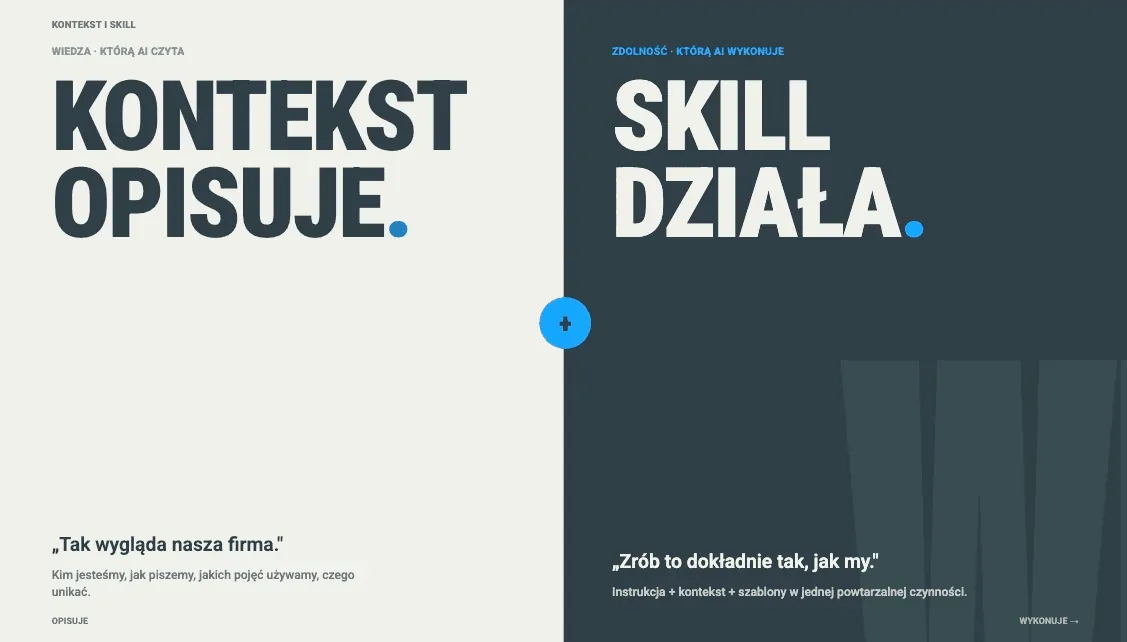
A skill is a packaged, reusable ability: an instruction plus context, and often also templates or tools, combined into one repeatable action. The difference is practical. A context file tells AI “this is what our company looks like.” A skill says “now do this specific thing exactly the way we do it” and gives the same standard every time.
Examples that are easy to picture: “prepare a proposal in our standard,” “make a presentation on our company template,” “analyze this data file and make a chart according to our rules,” “check the document for compliance with our policy.”
And here the same three levels appear as with context:
Personal skills - my recurring workflows, which I tune for myself.
Team skills - shared team procedures, performed the same way by everyone.
Organization skills - company standards: a proposal generator, a presentation generator in the visual identity, a compliance checker. Built once, they work for the whole company.
Why are skills so powerful? Because they accumulate expertise and make the company independent of individual people. When your best specialist codifies “how we do a good proposal” as a skill once, the whole organization gets it, without having to ask that person every time. Knowledge stops living in one head. It is a direct antidote to the two most common problems of AI adoption: the situation where “AI works, but only for three power users,” and the loss of knowledge when such a person leaves the company.
It is also the mechanism that carries value from a narrow group to the whole organization, that is, it does exactly what we wrote about in the context of adoption: it moves the company from a few percent of actual AI usage toward a state in which everyone who should be using it does. We work this way ourselves: the entire WeAreFuture organization runs on Claude from Anthropic (we are part of the Claude Partner Network), and it is in Claude that we manage company context files and skills. We base recurring work, from generating proposals to analyses, on this shared asset, so that everyone gets the same standard without guessing and without depending on one person.
We described prices and differences between plans in the guide to Claude plans for business.
Why shared context and skills are a lasting advantage
The arguments that reach the board’s desk, gathered in one place:
Durability. The model is a commodity that everyone has. Context and skills are yours and unique, because they come from your processes and knowledge.
Accumulation. Every good file and skill works for everyone, over and over. Value grows over time instead of disappearing after one conversation.
Consistency and quality. Less divergence between people, fewer errors, one standard of communication and work.
Resilience to turnover. Knowledge stays in the company instead of leaving with the employee.
Scale of adoption. Value stops being locked with a few power users and becomes available to the whole organization.
There is, however, a flip side. Exactly the same assets, left unmanaged, turn into a new kind of chaos: three conflicting versions of company context circulate, one contains an outdated price list, another sensitive data that should not be there. A shared asset without rules is just as risky as no asset. That is why the second half of this puzzle is governance.
Governance: how to manage shared context and skills
When context and skills become a shared asset, they have to be managed like any other company asset: code, data, documents. This is not about bureaucracy, but about six simple things that decide whether the asset stays current, consistent and secure.
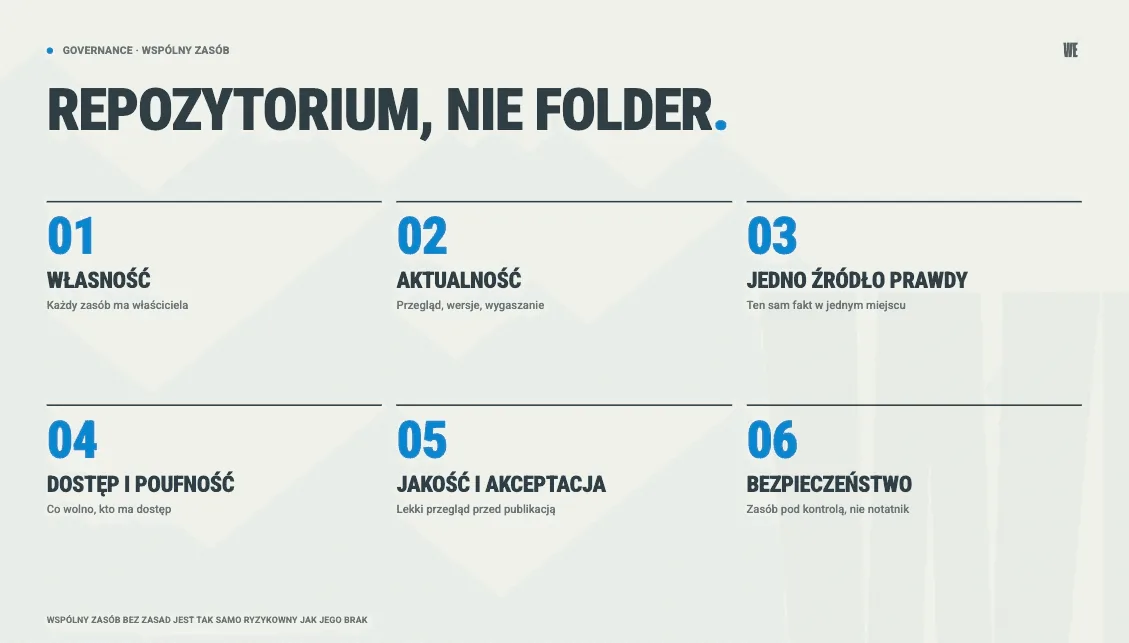
1. Ownership. Every asset at the organization level has an assigned owner. Without it nobody feels responsible for updating, and the asset quietly rots. This is the first and most often skipped decision.
2. Currency and lifecycle. Context goes out of date: the product, price list, process, structure change. It has to be reviewed, versioned, and what is outdated has to be retired. Outdated context is worse than none, because AI will state false information with full confidence, and nobody will catch it.
3. A single source of truth. The same fact cannot live in three places in three versions. Set one place that the lower layers inherit from, and make sure teams do not copy company context on their own, but refer to it.
4. Access and confidentiality. You need to state clearly what may be placed in shared context at all (not secrets, not sensitive data without control), who has access to which skills and contexts, and how confidentiality levels are separated. It is the same problem as “shadow AI” and the obligations arising from the AI Act, so it is worth setting these rules right away. Where the company stands today, including its rules for data and risk, is shown by AI Check: 20 questions, about 7 minutes, full results without email.
5. Quality and approval. Before a skill or context becomes a company standard, someone has to approve it. A light review is enough, similar to the one done for code, so that nothing wrong or inconsistent with the brand ends up in the shared pool.
6. Security. Skills can perform actions, and context can contain sensitive information. They have to be treated as a controlled asset, not as a notepad that anyone can write into as they please.
In practice it comes down to one thought: treat context and skills like a repository, not like a folder of files. Versioning, an owner, a simple review, periodic updates and confidentiality classification. Lightly, but consistently. The goal of governance is not to slow the company down, but to make sure the shared asset helps instead of quietly misleading everyone.
How to start: from a personal file to a company standard
You do not need to start with a big program. A sensible order looks like this:
Start at the personal level. Let the people who already use AI write down their context files. The effect is visible in days, with no dependencies.
Catch the recurring patterns. What repeats across several people, lift to the team level as shared context and first templates.
Build the organizational foundation. Company description, tone, rules, reference data, with one clearly named owner.
Codify one or two of the most common processes as company skills. Start with those that have the highest volume and the biggest quality gap between people, because that is where the gain is largest.
Set up light governance from day one. Owner, review, confidentiality classification. It is much cheaper to set this up at the start than to clean up a mess after a year.
A quick win for one or two weeks: a workshop where the team writes down a shared glossary of terms and turns one recurring process into its first team context file or skill. It is a small step that immediately shows the difference and builds an appetite for more. If you lack the basics and wonder where to start at all, a good starting point is AI training for business, because shared context is easier to create when the team understands how AI uses it.
Context and skills in the bigger picture
Context files and skills are not a separate, technical topic. They are part of the data, adoption and governance layer in every mature AI implementation. They connect directly with what we wrote earlier: in the distinction between an agent and automation we showed that an agent without good context and clean data is an expensive demo that falls apart in production. Context and skills are exactly what separates the one from the other.
This dependency is most visible with agentic tools that work directly on your folders - we laid it out in the comparison of Claude Cowork and Copilot Cowork.
For us, context files and skills are part of the AI Engine, a shared company context used by people and agents. It is the foundation on which specific implementations stand. And how this whole area fits into a broader AI transformation in a company, next to strategy, people, technology and governance, we describe separately.
If you want to organize shared context and skills in your company, instead of letting the value of AI end with a few power users, this is exactly the moment. At WeAreFuture, a Polish AI advisory and implementation firm from Warsaw, we set this up for clients every day. See how we build the AI Engine together with the client’s team, or book a call, and we will show you what it would look like at your company and where to start in your AI implementations.
Frequently asked questions (FAQ)
What is context in AI?
Context in AI is everything the model gets besides the question itself: a description of the company, processes and standards, a glossary of terms, rules, examples of a good result. The same model with good context gives material ready to use, and without it a generic one. In a company, context is made durable in context files and skills, built at the level of the person, the team and the organization.
What are skills in AI?
A skill is a packaged, reusable AI ability: an instruction plus context, often also templates and tools, combined into one repeatable action, e.g. “prepare a proposal in our standard.” Once built, a skill gives everyone in the company the same standard of execution and makes knowledge independent of individual power users.
How does a context file differ from a prompt?
A prompt is a one-off instruction that disappears after the conversation. A context file is a lasting, reusable document that AI has “in the background” in every conversation: who the recipient is, how we write, which terms we use, what to avoid. A prompt helps once, one person. A good context file helps many times, everyone who uses it.
How does a skill differ from a context file?
A context file is knowledge that AI reads (“this is what our company looks like”). A skill is an ability that AI performs (“do this specific thing exactly the way we do it”). A skill often contains context, plus a step-by-step instruction and sometimes templates or tools. In short: context describes, a skill acts.
Is a context file the same as RAG or a company knowledge base?
No, although they complement each other. RAG (and knowledge bases) retrieve relevant fragments from a large set of documents on demand, at the moment of the query. A context file is a concise, curated instruction that you attach always, regardless of the question. RAG answers “what is in our documents,” and a context file answers “who we are and how we are supposed to work.” In a mature implementation they work together.
Who should own organizational context?
Someone clearly designated, who is actually responsible for keeping it current, usually on the side of the person responsible for communication, operations or data, with the support of the owner of the AI topic. The most important thing is that it is a specific person, not “everyone,” because an asset without an owner is not updated by anyone and quickly loses value.
What data should not go into context files?
Secrets (passwords, keys, tokens), sensitive and personal data without proper control, and also information under special confidentiality, if access to a given context is not properly restricted. The rule is simple: before you add something to shared context, think about who will be able to see it, and whether the tool and its compliance settings allow it.
How often should context and skills be updated?
Always on a significant change (product, price list, process, brand) and as part of a regular review, even a quarterly one. Outdated context is worse than none, because AI will state outdated information with full confidence. Versioning and a named owner make updating a routine rather than a rescue operation.
Does this work regardless of the tool we use (Claude, ChatGPT, Copilot)?
Yes. The idea of context files and skills itself does not depend on the vendor, only the mechanism changes (projects and instructions, custom assistant configurations, dedicated contexts in agentic solutions). That is why it is an investment resilient to a change of tool: you carry over your context and standards even if you change the platform.
Where to start?
At the personal level: let the people already using AI write down their context files. Then lift recurring patterns to the team level, build the organizational foundation with one owner and codify one or two of the most common processes as company skills. From the start, set up light governance: owner, review, confidentiality classification.
Sources
Stanford HAI, AI Index Report 2025: State of AI in 10 Charts - inference cost drop of more than 280x (2022-2024).
Eurostat, 20% of EU enterprises use AI technologies (December 2025) - AI adoption in companies: EU 20%, Poland 8.4%.
Regulation (EU) 2024/1689 (AI Act), EUR-Lex - obligations for AI systems.
