
In 2026 almost every mid-sized and large company in Poland is “doing something with AI.” According to the EY study from December 2025, 34% of mid-sized and large enterprises in Poland have completed their first AI implementations, and another 43% are in progress. Few companies are actually transforming. Those are two completely different things. Buying assistant licenses, launching a chatbot in one department or automating a few processes are individual actions, useful, but not yet a transformation. AI transformation is a lasting change in how a company operates, makes decisions and competes, and it touches strategy, people, technology and the rules of the game all at once.
This guide is a complete map of that change, written from an advisory and management perspective, not a technical one. WeAreFuture is a Polish AI advisory and implementation firm from Warsaw - we lead companies through transformation from diagnosis to implementation and maintenance, and this material collects the experience from those projects. We will go through what AI transformation actually means (four dimensions), how to measure where you are (five maturity phases), where to start (a readiness audit), in which areas it is implemented, what it looks like in practice and when it is better not to start. At the end we will show how it all ties into one methodology.
Why Polish companies think about AI transformation the wrong way
Before we answer what transformation is, we need to name three wrong patterns of thinking that most often derail it. We meet them in companies of every size.
Pattern 1: “AI transformation = deploying tools.” The most common. The company buys licenses (classically a productivity assistant for everyone) and decides it has “implemented AI.” After a few months it turns out that only a handful of people use them, processes have not changed, and the invoice arrives every month. A tool is not a transformation. Transformation starts where the way of working changes, not only the set of applications.
Pattern 2: “It’s an IT project.” The second most dangerous. The AI topic is delegated to the IT department, with no sponsor on the board and no involvement from the business. IT delivers the technology, but a transformation that does not change business processes and does not engage the people who are supposed to use it gets stuck at “we have a nice tool nobody uses.” AI is a board topic, not only the CTO’s.
Pattern 3: “We’ll do it with one big program.” The third pattern is the extreme in the other direction: an ambitious, multi-month “transformation program” that either ends in a big bang that drifts away from reality, or bogs down in analysis paralysis before anything reaches production. AI transformation succeeds in stages (through a series of measured implementations that build maturity), not in one big leap.
All three patterns share a cost: a scattered budget, the risk of uncontrolled AI use (shadow AI), the organization’s fatigue with successive “initiatives” and, most painfully, the loss of the board’s trust when after a year there is no visible return. The most common symptom of this state is plain implementation chaos; how to put it in order, we described in the guide to AI implementations in a company.
Who owns AI transformation
If AI transformation is not an IT project, the question arises: whose project is it? The answer that works in practice is: the board’s. Not because the board has to understand the architecture of models, but because transformation cuts across all the company’s functions and requires decisions that cannot be made at the level of a single department: what we allocate the budget to, which processes we move first, how we reconcile AI with risk and compliance, whose time we engage.
What exactly stays at the board level and what can be handed to the team, we lay out in a separate text: AI advisory for the board.
In companies where transformation actually gets moving, several repeatable roles are visible. A board sponsor is a decision maker who gives the topic a mandate, releases the budget and settles priorities. A business owner on the process side is the person responsible for the implementation changing the way of working rather than ending up as an unused tool. Technology support (internal or from a partner) is responsible for data, architecture and the actual building of solutions. And finally a network of ambassadors, that is, people in teams who translate the change into everyday work and pull the rest of the organization along.
The most common mistake is to staff only the technology role (“we have a team that will do it”) and to skip the sponsor and the business owner. Then even a technically good implementation has nobody to “buy” it inside the company or to plug it into a process. The role of an external partner here is usually supporting: to speed things up, bring experience from other implementations and build internal competence, but not to replace the mandate that has to come from above.
What “AI transformation” means - four dimensions
AI transformation is a change in four dimensions at once. Skipping any one of them is the most common reason transformations fail, because companies usually focus on one (technology) and neglect the rest.
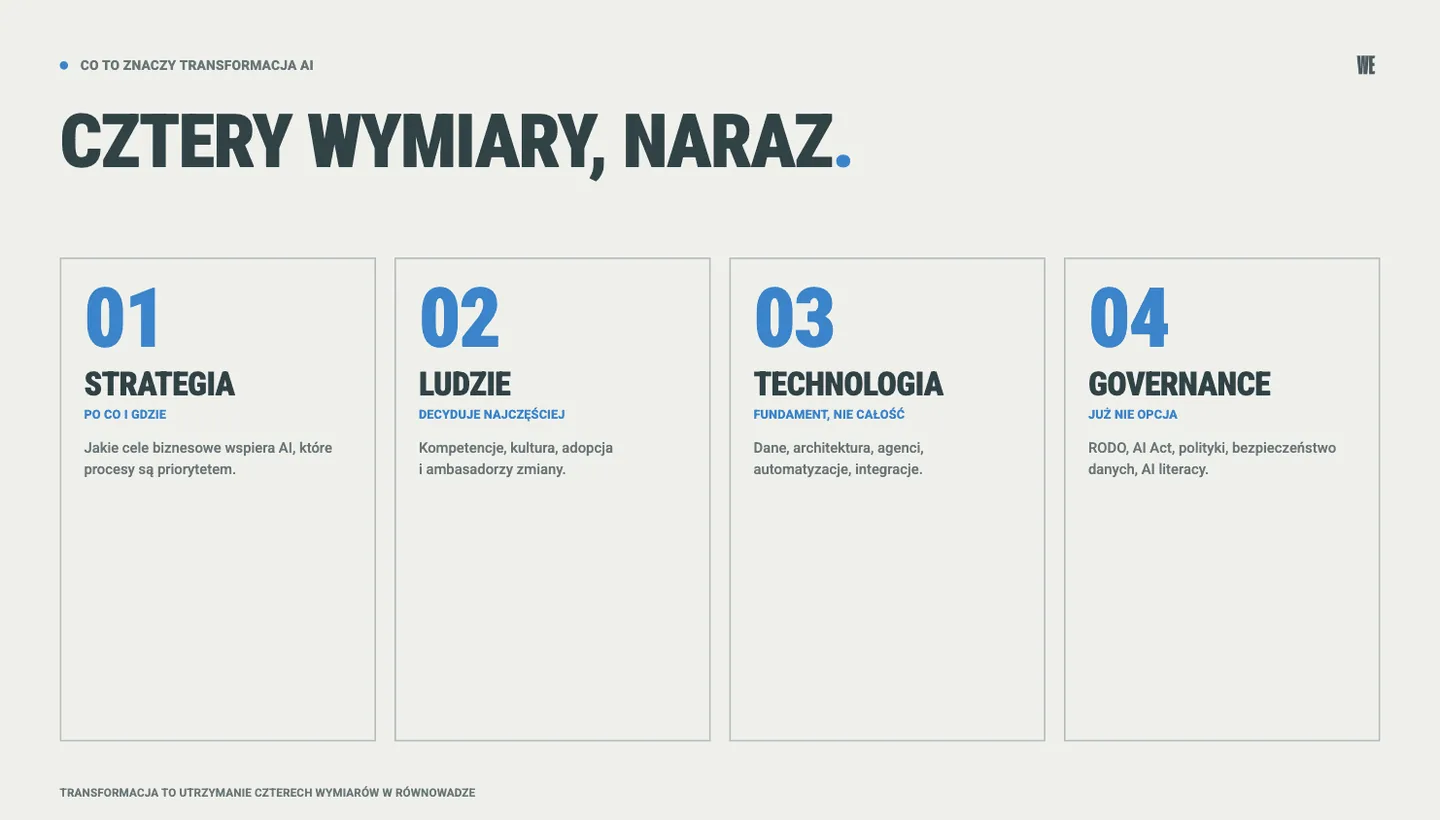
1. Strategy. Why are we implementing AI at all? Which business goals is it to support: growth, margin, time, quality, customer experience? Which processes and areas are a priority, and which will wait? Without this dimension, transformation becomes a set of random experiments with no direction. A typical mistake: announcing an
“AI program” without indicating what specific business goal it is meant to serve.
2. People. This is the dimension that decides success more often than technology. Competence (does the team understand what to expect from AI), culture (do people treat AI as a threat or a tool), adoption (do they actually use it) and change leaders, that is, ambassadors who will pull the rest of the organization along. A typical mistake: investing in tools without investing in competence and adoption, and then being surprised that nobody uses them.
3. Technology. Data, architecture, agents, automations, integrations with existing systems. This is the dimension everyone thinks of first, and rightly so, because it matters, but on its own it is not enough. The best technology without strategy, people and rules is an expensive shelf of tools. A typical mistake: starting with the choice of a model or tool before it is known what data is available and for what.
4. Governance. The rules of the game: compliance (GDPR, the AI Act), policies on using AI, data security, ethics and accountability. In 2026, with the obligations arising from the AI Act regulation, this dimension has stopped being optional: among others, the requirement for AI competence in the organization (so-called AI literacy) applies, and further obligations depend on the risk level of a specific use - some deadlines have been moved, which we described in the post on the AI Act delayed by 18 months. In practice this means the need to know what data goes into models, where it is processed and who is responsible for each use. Governance is not a brake on transformation, but the condition that allows you to scale it without exposing the company. The most common mistake is to treat it as a formality tacked on at the end, instead of designing compliance in parallel with the implementations.
This dimension most often falls over on what nobody sees: unauthorized use of AI tools by employees. We broke it down in the text on shadow AI and AI governance in a company.
AI transformation is keeping these four dimensions in balance. A company that has great technology but has not looked after its people will get tools without adoption. A company that has strategy and people but not a data layer or governance will get stuck on pilots. Maturity is parallel progress on all four fronts.
Five phases of AI maturity
To plan a transformation, you first need to know where you are. At WeAreFuture we use our own model of five phases of AI maturity. It is both a diagnosis (“where are we today”) and a map (“where are we heading and what is the next step”).
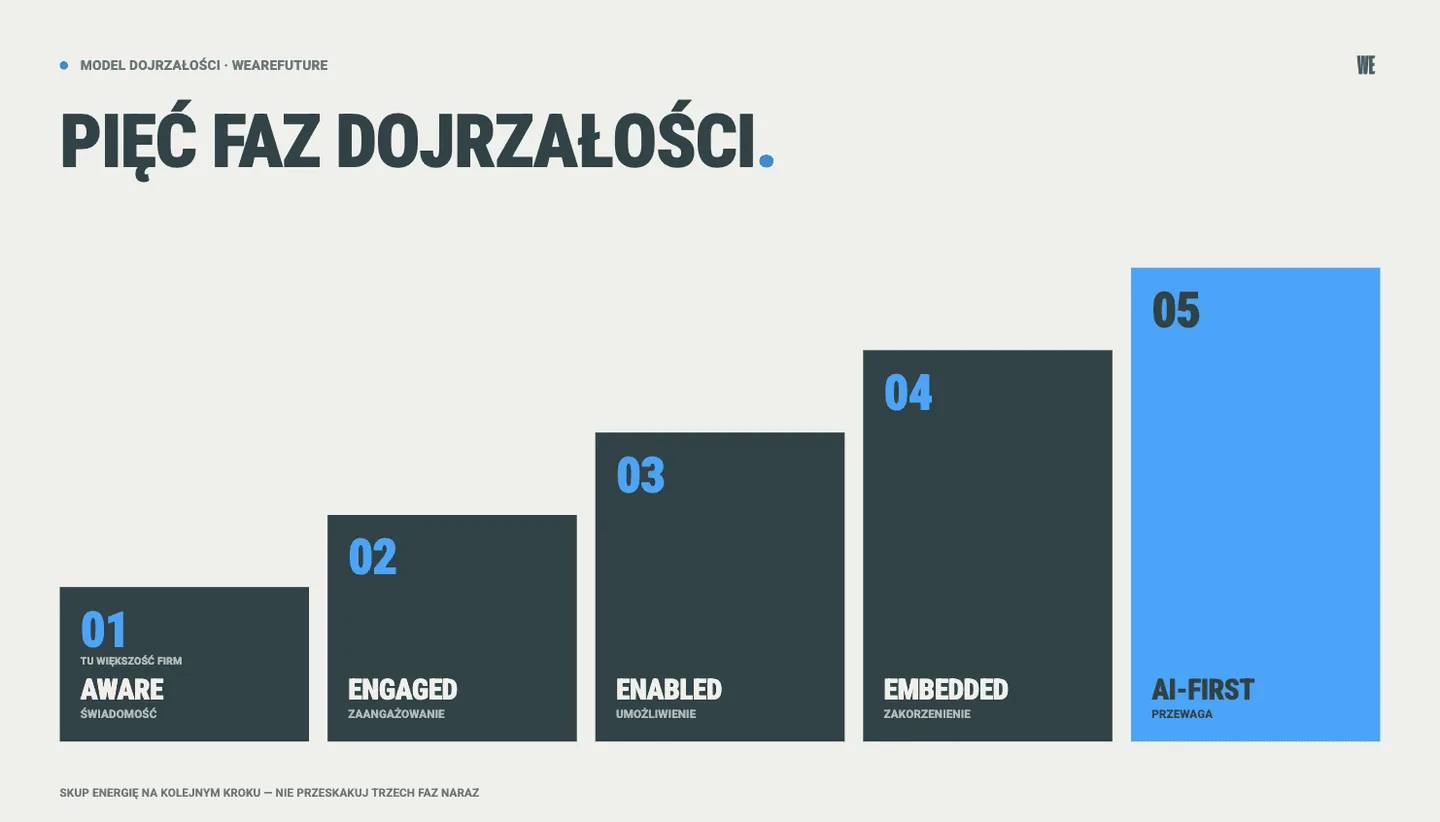
Phase 1, Aware (awareness). The company notices AI, but acts chaotically. Bottom-up experiments appear, employees use private tools (shadow AI), and there is no strategy, owners or policies. This is where most Polish companies are today. Next step: name a topic owner on the board, set a basic policy on using AI and choose the first measured pilot, instead of letting AI “happen” in the background.
Phase 2, Engaged (engagement). The first deliberate pilots with assigned owners and goals. The first policies on using AI appear, training starts, the board begins to take the topic seriously. Experiments stop being random. Next step: build a foundation so that subsequent implementations do not start from scratch: an organized data layer and repeatable delivery rules.
Phase 3, Enabled (enablement). The company builds the foundation: a data layer, governance, a network of AI ambassadors. Implementations become repeatable, because there is an architecture and rules by which they are delivered. This is the moment when AI stops being a “project” and becomes a capability of the organization. Next step: scale implementations in key processes and assign them hard KPIs, instead of multiplying isolated use cases.
Phase 4, Embedded (rooting). AI is wired into key business processes, measured by specific KPIs and scaled across the organization. It is not an add-on, but part of how the company works day to day. Next step: design new processes and products around AI from the start, instead of bolting it onto existing ones.
Phase 5, AI-First. AI becomes the default way of operating. New processes and products are designed around AI capabilities from the beginning, instead of adding it later. It is a state that few organizations reach today, and that is exactly why it gives a competitive advantage. Here the game is no longer about catching up, but about keeping the advantage, and not handing it to faster competitors.
The value of this model is practical: it lets you honestly name which stage the company is at and focus energy on the next step, instead of jumping three phases at once. The most common mistake is a company in the Aware phase that tries to act like AI-First right away and crashes against the lack of foundations.
AI transformation and company size: what scale changes
Although the four dimensions and five phases are universal, the road through transformation looks different depending on the scale and context of the company.
Smaller and mid-sized companies usually have a simpler data landscape and a shorter decision path, so they can launch the first measured use case faster and see an effect. Their limit is most often a lack of hands and internal competence, so a sensible sequence is: one specific process, a quick result, and only then a broader data layer and further implementations. The risk is starting with a program that is too ambitious, “everything at once,” for which there are no resources.
Large organizations have more data, budget and processes, but also more silos, integrations and stakeholders. Here the foundation (data layer, governance, architecture) is heavier to lay, but once it is built, subsequent implementations scale much faster. The biggest risk is paralysis: a multi-month analysis in which nothing reaches production. The remedy is parallelism: build the foundation and at the same time deliver the first visible implementations, which keep the board’s faith in the whole.
Companies from regulated industries (finance, healthcare, the public sector) have an additional dimension: sensitive data and requirements that often settle the architecture, for example the need to keep data in their own environment. For them, governance and architecture decisions are not a stage that “also has to be done,” but the starting point on which it depends what may be implemented at all. It is usually a longer road at the start, which pays off in trust and resilience to risk.
The common denominator is one: regardless of scale, transformation succeeds in stages and with a clear owner; the pace and order change, not the principle.
Readiness audit - where to start
Transformation does not start with choosing a tool or announcing an “AI program.” It starts with an honest assessment of where the company is and what blocks it. We check five areas:
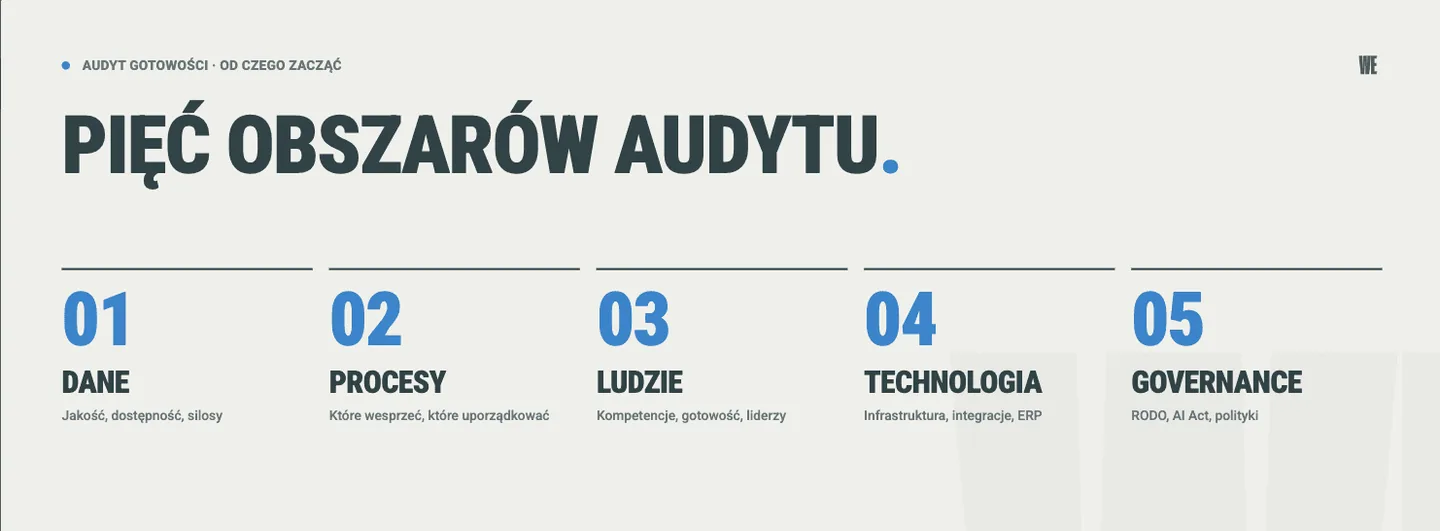
Data: quality, availability, silos. Does the data that implementations need exist in a usable form?
Part of this layer are context files and AI skills, which build shared context in a company - from the level of a person to the whole organization.
Processes: which are worth supporting with AI, and which to put in order first.
People: competence, readiness for change, adoption leaders.
Technology: infrastructure, integrations, planned migrations (e.g. an ERP change).
Governance: compliance (GDPR, the AI Act), policies, security.
The result of an audit is not a report for the drawer, but a diagnosis of the maturity phase and a prioritized list of actions, that is, a starting point from which it is clear what to do first. You can do a preliminary version for your company in our AI Check (20 questions, about 7 minutes, results without email), and we carry out the full, strategic assessment as part of AI consulting and strategy.
Five areas of AI transformation at WeAreFuture
Transformation, described in the abstract, sounds overwhelming. In practice it is delivered in five areas, which together cover the four dimensions from the earlier section. We develop some of them in separate, detailed guides, and this is a good place to go deeper into the topic that interests you.
1. AI education and training. The foundation of the “people” dimension. Without understanding what AI is and what to expect from it, every implementation ends in low adoption. How to approach it systematically (from awareness to practical skills), we describe in the guide to AI training for business (see also our AI training service).
2. AI advisory and strategy. The “strategy” dimension. This is where you set why and where to implement AI, how to prioritize and how to translate it into business goals and a board mandate. This is how we work as part of the AI strategy and advisory service.
3. AI implementations: data, agents, automations. The heart of the “technology” dimension. This is where the data layer, AI agents and automations are built. How to put this in order, we describe in the guide to AI implementations step by step, and you will find the key distinction in the guide on AI agents and automation (and in the AI implementations service).
4. Adoption and change management. The second pillar of the “people” dimension: what happens after a tool is deployed. Without an adoption program, even the best solution ends up with a few percent usage. What it looks like in practice we show using the example of AI adoption at a manufacturing company.
5. Productivity tools (Microsoft Copilot). Often an organization’s first contact with AI in daily work. The key: deploy them so that they actually raise productivity and do not become one more unused license - and that is decided by the adoption program, not the license itself.
AI transformation touches all five areas, but you do not need to (and should not) move on all of them at once. The sequence is set based on the maturity phase and business priorities. In practice the early phases usually start with education and the first, well-chosen implementations; the data and governance foundation comes in when more implementations are planned; and adoption and productivity tools scale in parallel when the organization is ready to use them.
What transformation looks like in practice: case studies
Three implementations from our practice, each showing a different dimension of transformation in action.
A manufacturing company: the technology and implementation dimension
A Polish manufacturer (a manufacturing company handling about 2,000 requests for quotation a month) handled requests for quotation manually - the process took up to 7 days. Today the whole process of handling requests is run by an AI agent integrated with the ERP, CRM, knowledge base and product data (PIM), and the time to handle a request has shortened from several days to around one day. It is an example of a mature technology dimension: a data layer, an agent and automation combined into one working implementation that took repetitive, time-consuming work off the sales team. In the language of maturity phases, it is an organization that in the area of sales already operates close to the Embedded level: AI is wired into a specific process and works on it every day.
A financial company: the governance and architecture dimension
At a financial company in a regulated sector we set up a secure on-premise infrastructure: an internal sandbox in which data does not leave the client’s environment, and language models are available to automations. Part of the implementation was training for the business, so that teams could build further solutions on their own. It is a transformation led from the governance side: an architecture decision (on-premise, because of regulatory requirements) and building internal competence as the starting point. It shows that in regulated industries the order is sometimes reversed: first architecture and compliance, and only on that foundation specific implementations.
A pharmaceutical company: the people and adoption dimension
At a global pharmaceutical company, adoption of an internal AI assistant grew from limited use to regular use by most of the team, not thanks to a change of technology, but thanks to a change management program: selecting ambassadors and dedicated training delivered directly in the tool that employees use. It is proof that the value of a transformation is most often decided by the human dimension, not by the technology itself. The same license without an adoption program would have produced a few percent usage; the difference was made by the “people” dimension, not by a change of tool.
These three cases show the same truth from three sides: AI transformation succeeds where a company consciously works on technology, governance and people, not on only one of them.
What AI transformation costs and how to calculate its return
The question about cost comes early and rightly so, but “how much does AI transformation cost” is the wrong question, because transformation is not one purchase, but a sequence of investments spread over time. Instead of one number you need to look at three things: the cost structure, the horizon of return and where the money actually goes.
Where the budget really goes. Contrary to intuition, the most expensive thing in a transformation is not the “AI model”: models are relatively cheap and available today. The largest share of cost and time is usually absorbed by the data layer: bringing data to a state in which implementations have something to draw on: integrations, organizing, access, quality. This applies especially to “conversation with company data” scenarios, where the value of the solution is exactly as good as the data underneath. The second underestimated item is maintenance: an implementation is not a project with an end date, but a solution that has to be monitored and developed.
How to think about orders of magnitude. Individual implementations differ in cost by an order of magnitude depending on type and number of integrations: simple automation is the cheapest, an agent integrated with several systems is significantly more expensive. That is why transformation is not priced “up front, as a whole,” but in stages: audit and decisions, then the foundation, then specific implementations, each with its own business case. This arrangement also has a financial advantage: it lets you stop or change direction after each stage, instead of committing the whole budget to one big program.
If you are looking for external funding for any of the stages, we described the paths for SMEs and for large companies in the guide on how to finance an AI implementation.
How to calculate the return. The return on transformation is not calculated at the level of the whole program, because that is too abstract to mean anything. It is calculated per implementation: each solution is assigned a metric (time, cost, quality), the state is measured before and after, and on that basis the decision on scaling is made. The sum of such measured cases gives a credible picture of the return on the whole and hard arguments for the board, stronger than the promise “AI will increase efficiency.” The most common mistake on the expectations side is counting on an immediate return without investing in people and data; transformation pays back, but on a horizon of quarters, not weeks, and provided that adoption has been looked after.
When NOT to start a transformation
Honest advice also means saying outright when it is better to hold off or start differently. These are the situations in which “starting an AI transformation” will do more harm than good.
No sponsor on the board - build the mandate first. A transformation delegated downward, without real support from decision makers, will sooner or later get stuck for lack of budget and priority.
No data readiness - start with the data foundation, not with ambitious implementations. Transformation on scattered data is building a house without foundations.
“Transformation for transformation’s sake” - if you cannot name the business goal that AI is meant to address, define the goal first. AI is not a goal in itself.
A company in deep crisis or restructuring - stabilize the basics first. AI transformation requires attention and resources that an organization in survival mode usually does not have.
Expecting immediate ROI without investing in people - correct the expectations. Transformation pays back, but not overnight and not without the team’s involvement.
This filter does not discourage transformation, but helps to start it at the right time and in the right way, so that it actually succeeds.
How to tell that AI transformation is heading in the right direction
Transformation rarely “succeeds” or “fails” overnight; more often it slowly heads in a good or bad direction, and the board only realizes after the fact. So watch a few simple signals, without waiting for an annual summary.
Signs that it is going well. The number of implementations that actually reach production grows, instead of ending as demos. Employees themselves report processes for improvement, instead of treating AI as a top-down obligation. Ambassadors appear who teach others. Successive implementations are faster and cheaper than the previous ones, because they use the data layer and rules that are already built. And, most important, for every implementation you can show a specific metric that improved.
Warning signs. Lots of “pilots” that never finish and never reach production. Tool adoption measured in single-digit percentages. Recurring “shadow AI,” because the official solutions are inconvenient. Every implementation starts from zero, because there is no shared foundation. And growing fatigue in the organization with successive “AI initiatives” that nobody remembers after a quarter.
The rule is simple: a healthy transformation is visible in numbers and in people’s behavior, not only in the number of licenses bought. If the only thing growing is the cost of tools, and not their actual use and measurable effect, it is a sign that the company has fallen into one of the three patterns described at the start, and that it is time to go back to the foundations.
The AI Engine and our collaboration model: how it all fits together
Everything we discussed (four dimensions, five maturity phases, the audit, five areas, the decision filter) are elements of one whole. Tying them into a coherent, guided change requires a methodology. At WeAreFuture we work on the AI Engine: a shared company context used by people and agents: data about customers and products, procedures written down step by step and decision rules, connected to the company’s systems. We build it in stages, process by process: a WeAreFuture team, an AI consultant and an AI engineer, works alongside your people, and every stage ends with an assessment of the effect and a decision on the next one.
The difference between “doing something with AI” and building a shared AI Engine is like the difference between a series of individual renovations and having an architect who makes sure the whole holds together and heads in one direction. The first gives impressive fragments. The second gives a company in which AI actually works and measurably pays back.
If you recognize your organization in one of the early maturity phases and want to plan a staged way forward, that is where we start every collaboration. See our collaboration model, or book a call, and we will show you what that road would look like at your company.
Frequently asked questions (FAQ)
How does AI transformation differ from AI implementation?
An AI implementation is a single solution: an agent, an automation, an assistant. AI transformation is a lasting change in how the whole company operates, covering strategy, people, technology and governance. Implementations are elements of transformation, but a sum of random implementations does not yet make a transformation, because it lacks direction and coherence.
Where to start AI transformation in a company?
With a readiness audit and an honest diagnosis of the maturity phase, not with buying a tool. The audit shows what blocks the company (most often data or competence) and lets you set priorities. The second step is securing a sponsor on the board and defining a business goal.
How long does AI transformation take?
It is a continuous process, not a project with an end date; companies move through successive maturity phases over months and years. The first measurable effects from specific implementations appear quickly, though, usually in quarters, not years. The key is staging: measured implementations that gradually build maturity.
Is AI transformation an IT project?
No. Technology is only one of four dimensions. A transformation that is treated solely as an IT project (without the board’s involvement, change of processes and work with people) almost always ends with tools that nobody uses. It is a strategic topic, owned by the board.
How to measure the progress of AI transformation?
On two levels: maturity (moving through the five phases: Aware, Engaged, Enabled, Embedded, AI-First) and value (specific KPIs assigned to individual implementations: time, cost, quality). The number of tools deployed is not a measure of transformation; the measure is whether AI actually changes how the company operates and whether it pays off.
Is AI transformation compliant with GDPR and the AI Act?
It can and should be, because governance is one of the four dimensions of transformation, not an add-on at the end. The key is to design compliance from the start: knowing what data goes into models, where it is processed and who is responsible for it. In 2026, with the obligations of the AI Act, it is a condition of safe scaling, not a formality.
How much does AI transformation cost?
There is no single number, because transformation is a sequence of investments, not a single purchase. The largest share of cost and time is usually absorbed by the data layer, not the model itself; individual implementations differ in price by an order of magnitude depending on type and number of integrations. That is why it is priced in stages (audit, foundation, specific implementations), and the return is calculated per implementation, not at the level of the whole program.
Who in the company should be responsible for AI transformation?
The owner of the topic should be the board, because transformation cuts across all functions and requires decisions about budget, priorities and risk. In practice this arrangement works: a sponsor on the board, a business owner on the process side, technology support (internal or from a partner) and a network of ambassadors. The technology role alone is not enough: without a sponsor and a business owner, even a good implementation does not get wired into a process.
Sources
Regulation (EU) 2024/1689 on artificial intelligence (AI Act), EUR-Lex
AI Act, Article 4: AI literacy - artificialintelligenceact.eu
Data on the manufacturing company and pharmaceutical company implementations comes from projects delivered by WeAreFuture.
