
Artificial intelligence is no longer a futuristic vision. In 2026 it is a work tool in most mid-sized and large companies in Poland. But simply buying Copilot or Gemini licenses changes nothing if people do not know how to use them in their daily work. That is why AI training for companies is today one of the key elements of transformation, but only when it is well matched to where the company actually is.
It is worth adding that AI skills are now an obligation, not a good practice. Article 4 of the AI Act obliges companies to ensure an adequate level of AI literacy among employees, and it has applied since 2 February 2025.
This guide is addressed to people in HR, Learning and Development, board members and transformation leaders who face the question: which training to choose, for whom, at what moment, and when to give up on the investment. We show 4 types of AI training, each with clear criteria for when it delivers results and when it turns out to be an ineffective investment. We draw on practice from Polish companies and enterprises.
Why most AI training does not deliver results
Let us start with the question of why the budget spent on AI training often does not pay back. In our experience at WeAreFuture, the same three causes keep recurring.
No coherent strategy. Training is treated as a one-off event, detached from the transformation plan. Employees leave the room with new knowledge but without a clear path for applying it in their daily work.
A poor match of training type to the organization’s maturity. Training programs are often too general or too technical. General presentations on “what AI is” do not deliver practical skills, while overly specialized courses are incomprehensible to people without the right preparation. What matters is matching content to specific roles and needs, which is often overlooked.
No internal ownership of continuing the program. After a one-off training the organization has no regular knowledge-sharing formats and no structure responsible for adoption. Without this, employees return to old habits within 2-4 weeks.
Good AI training is not a single event. It is the choice of the right type of intervention at the right moment. That is why the starting point must be understanding which types of AI training exist at all.
An AI training program: 4 levels of the organization
An effective AI training program must be matched to different groups in the organization. There is no single universal training that will meet the needs of both the board and specialists from every department.
Each level differs in three things: who the audience is, what type of program it is, and when it is not worth doing at all. Many organizations waste budget because they buy training from the wrong level or at the wrong moment.
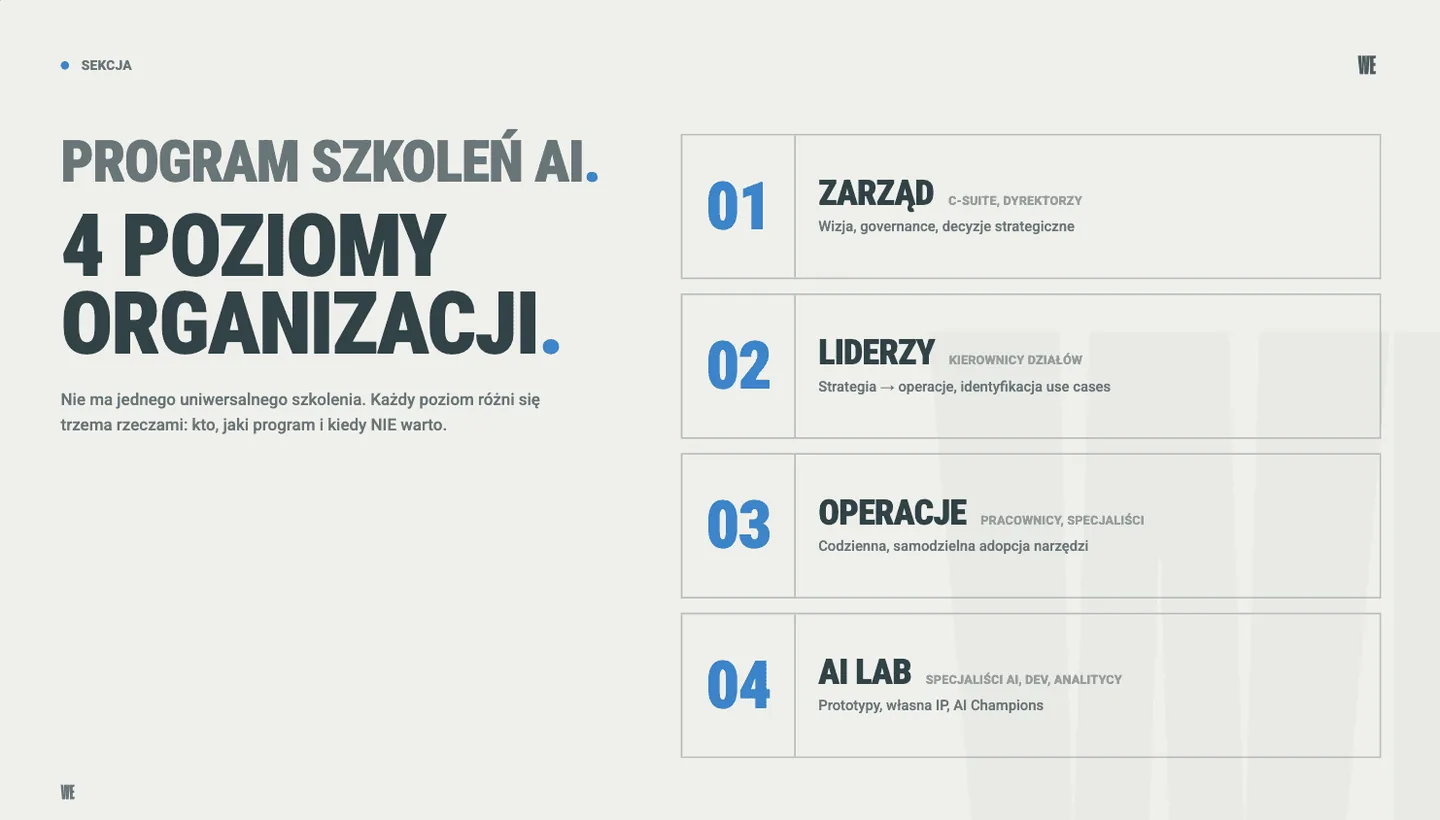
Level 1: The board (C-suite, directors, transformation leaders)
Goal: aligning the AI vision, governance, strategic and investment decisions. At this level it is not about operating tools but about choosing the direction and the management framework.
Program profile: short inspiration sessions (2-6 hours) that set the direction, or strategic workshops (1-2 days) that turn inspiration into a roadmap with KPIs and a governance model.
What it covers:
AI strategy and business model innovation: how AI changes the industry, where to look for new sources of competitive advantage, how to design the organizational architecture around AI.
Governance, ethics and compliance: regulation (the AI Act), risk management, internal policies and standards.
Measuring ROI and scaling: how to evaluate AI investments, build an implementation roadmap, scale the transformation.
When NOT to do it: in organizations where AI awareness is already well established and it is time to move to implementation. Inspiration done with the motivation “because everyone is talking about it”, without a plan for follow-up, is an ineffective investment. If the only goal is keeping knowledge current, an industry conference or an internal webinar is enough.
A cheaper entry for the board is the free course “AI for Business Leaders” in the Polish Development Fund (PFR) Knowledge Zone, which we co-create as a subject-matter partner. We collected it together with the other programs in our overview of free AI courses with a PFR certificate.
Level 2: Leaders and managers (department heads, team leaders)
Goal: translating the AI strategy into concrete operational actions, identifying use cases in their teams, leading change and supporting tool adoption.
Program profile: specialized workshops (1-2 days) in which a leader with key people maps processes in their area, identifies the areas with the highest ROI potential and designs implementation pilots.
What it covers:
Identifying and prioritizing AI use cases: how to analyze processes in a department and find the places where AI will bring the most value. How to build business cases for projects.
Managing a team in the age of AI: how to motivate people to use new tools, how to deal with resistance to change, how to build a culture of experimentation.
AI tools for the manager: practical uses in analyses, reports, decision support.
When NOT to do it: in organizations with a low degree of process order. Artificial intelligence does not solve basic problems, and even highlights them. If a department has no mapped customer service process, the first step should be work on the processes themselves, and only second the implementation of AI.
Level 3: Operations, dedicated domain training (managers, specialists)
Goal: everyday, independent use of AI tools in tasks, greater efficiency and automation of routine work. This level decides adoption at the scale of the whole organization. If operational teams do not use the tools, the transformation remains only a declaration.
Program profile: adoption training for a specific tool or domain, e.g. marketing, sales, IT. Goal: bring people to daily, independent use of the tool in their daily work. One meeting is an intensive half day, usually 3-6 sessions spread over time plus follow-up.
Examples of dedicated domain training:
AI for B2B Sales - how to shorten the time to prepare offers and follow-ups, generate personalized communication with the client, automate CRM updates and pipeline analysis. Participants leave the training with ready prompts and workflows plugged into their daily tools.
AI for B2B Marketing - building a Custom GPT with the brand’s tone of voice, speeding up content and creative production, automating competitor research and campaign briefs. The emphasis is on consistent communication at a high scale of production.
AI for Operations and Back Office - automating recurring reporting, analyzing and summarizing contracts, supporting forecasting and budgeting. The training eliminates tedious, repetitive tasks and shifts the team’s attention to analytical work.
AI for IT Teams - practical work with GitHub Copilot, Cursor and Claude Code: code refactoring, test generation, faster code review and documentation. A program matched to the team’s technology stack.
When NOT to do it, i.e. the most common trap: organizing adoption training on Copilot (or ChatGPT/ Claude) for teams that do not have paid licenses. The free browser version of Copilot is not the same as Microsoft 365 Copilot integrated with Office. No access to the tool after the training results in zero adoption. The order should be the reverse: first the license decision, then the training.
An example from our practice: at a manufacturing company we ran individual consultations on AI tools (Claude and Claude Code) that brought measurable results, because participants had paid access to the tools they were learning. Under different license conditions the same consultation format would not have been effective.
Level 4: AI Lab / Innovation Teams (AI specialists, developers, data analysts)
Goal: building internal AI competencies, creating prototypes, implementing custom solutions and your own AI products. This level is optional, but key for companies that want to develop their own technology IP and an AI-based competitive advantage.
Program profile: a comprehensive cohort program that combines inspiration, workshops and tool adoption into one structured process spread over time. A cohort of 12-25 people goes together through the cycle of ideation, prototype, business case, Demo Day. The format builds an internal community of AI practitioners who then act as catalysts of adoption in the rest of the organization.
What it covers:
AI Lab Accelerator. An intensive 2-week program that leads cross-functional teams (business plus IT, up to 25 people) from an idea, through prototyping, to a business case and Demo Day. Structure: pre-work 6h, workshop 8h, group work 6h, Demo Day 8h. Output: working prototypes and approved business cases.
Integrating AI with existing systems. Solution architecture, security, scalability, maintenance.
When NOT to do it: in organizations smaller than about 30-50 people, because they do not allow building a critical mass of participants. The format also does not work where the board treats the program as delegated training and does not get involved itself. Without active sponsorship the cohort loses momentum between modules.
Decision table
Level | Who | Program type | When NOT |
|---|---|---|---|
1. Board | C-suite, directors, transformation leaders | Inspirational and strategic (2-6h or 1-2 days) | When the AI vision is already aligned |
2. Leaders | Department heads, team leaders | Specialized workshop (1-2 days) | When processes are not in order |
3. Operations | Employees, specialists | Adoption (2-6 days plus follow-up) | Without paid licenses |
4. AI Lab | AI specialists, devs, data analysts | Cohort program (2 weeks to 6 months) | Small scale or no sponsor on the board |
More about the methodology of adult learning itself, how to design blocks and how to balance theory with practice, is described by Julia in our article on the 8 methods of learning.
In practice most organizations need to work on 2-3 levels at the same time. The most common pattern we see at clients: a strategic workshop for the board (level 1) plus adoption training for operations (level 3), with leaders (level 2) acting as AI Champions who pull adoption along between modules. AI Lab (level 4) is the next step for organizations that have already built basic adoption and want to develop their own implementations.
A second decision worth making in parallel is at what stage of AI maturity the organization is (AI Aware, AI Engaged, AI Enabled, AI-First). That is a topic for a separate article (link coming soon), in which we show the WeAreFuture maturity framework and how to sequence training interventions over time.
Questions boards do not ask before choosing a provider
The decision to choose an AI training provider is sometimes made in response to an attractive offer, without prior strategic analysis. Six questions that should be asked before signing a contract:
What type of training is it, and does it match the organization’s real needs? (see the section above). A provider with a high standard of work can say: “this is not the right moment for adoption training, first it is worth running a strategic workshop”.
How does the provider measure adoption effectiveness, and not only training completion? Can they show metrics of real tool use after the training, or do they limit themselves to issuing a certificate of attendance?
What is the model for sustaining results after the training? Who in the organization will maintain the momentum: regular knowledge-sharing formats, an adoption dashboard, internal AI Champions? Without this structure the effects of the training fade within 2-4 weeks.
Does the program take into account the specifics of the industry and the organization’s processes? A generic AI workshop for “everyone” has limited operational value. Providers with a higher standard of work precede the workshop with interviews with the leader and operational people, and then map use cases relevant to the given organization.
How does the training help counter the phenomenon of Shadow AI? Uncontrolled use of ChatGPT with company data creates legal, regulatory and reputational risk. Is the training program integrated with the AI policy in force in the organization?
In what situations should the investment in this specific training not be made? A provider with a high standard of work can point to the conditions in which their offer will not bring the expected results. The answer “always worth it” points to a sales approach, not an advisory one.
AI tools in training: what to teach to whom (Copilot, ChatGPT, Claude, Gemini)
The choice of tool is the second biggest factor, after the type of training, that decides the effectiveness of a program. Teaching generic “AI” without a specific tool has limited operational value. Teaching a tool that employees do not have access to is worth even less. The problem is not only access to tools. Although AI has already reached most mid-sized and large companies, only about 23% of companies actively use it. The rest have licenses but no adoption (PARP, the Polish Agency for Enterprise Development, and Jagiellonian University, 2026). The four main tools we train on in companies today:
Microsoft 365 Copilot - the leading choice for organizations deeply integrated with the Microsoft ecosystem. Integration with Word, Excel, Outlook, Teams, PowerPoint and SharePoint means adoption in administrative, financial and operational departments goes fastest. The most common mistake: equating the free “Copilot in the browser” with the full Microsoft 365 Copilot. These are two different tools with different capabilities. Adoption training on Copilot makes sense only with a paid M365 Copilot license (approx. USD 30/user/month). Microsoft recently added the ability to use Anthropic models alongside OpenAI models.
ChatGPT (OpenAI) - the most recognizable tool, and therefore often the first one employees look for on their own. In a company context we train on ChatGPT Business or Enterprise (not the free version, because of data protection issues and quickly exhausted limits). The tool is particularly effective in creative tasks, brainstorming, copywriting, text analysis and working with PDF documents. A good choice for marketing, sales, R&D and HR.
Claude (Anthropic) - the strongest in working with long documents (context above 1M tokens), legal analysis, coding and tasks requiring nuanced reasoning. Increasingly chosen by legal, compliance, finance and product departments. It was less popular than ChatGPT, but on specific use cases (contract analysis, long reports) it shows a clear advantage and has recently been becoming a leader in enterprises.
Gemini (Google) - a natural choice for organizations in the Google Workspace ecosystem. Integration with Gmail, Drive, Docs, Sheets and Meet. Strengths are data analysis in Sheets and meeting summaries in Meet. In teams already using Workspace, Gemini adoption goes most smoothly, because it does not require changing the work environment.
What to teach to whom: a short guide
Team / department | Main tool | Second tool |
|---|---|---|
B2B sales | ChatGPT (Business) | Claude (offers, contracts) |
Marketing | ChatGPT | Gemini (if Google Workspace) |
Operations / Back-office | M365 Copilot | Gemini |
Finance / Controlling | M365 Copilot (Excel) | Claude (analyses) |
Legal / Compliance | Claude (long documents) | M365 Copilot (Word) |
R&D / Product | Claude (research) | ChatGPT |
HR | M365 Copilot | Claude |
IT / Dev | Claude Code | Codex, GitHub Copilot |
In practice organizations most often standardize on 1-2 main tools (usually M365 Copilot or Gemini, plus a supplement). Rolling out four solutions in parallel leads to user confusion and operational difficulties on the IT side.
The client’s internal AI tools - organizations increasingly build their own AI agents, dedicated GPTs or internal assistants on the API layer. In such cases adoption training must be designed around the organization’s specific tool, not generic ChatGPT. These are usually more advanced implementations, as the case of a global biopharmaceutical company below shows.
Adoption metrics: how to measure whether training works (a pharma case)
Most organizations evaluate the effectiveness of AI training based on satisfaction surveys and the number of training completions. These are, however, reaction metrics, not adoption metrics. The real indicator of a program’s effectiveness is the level of AI tool use in operational work three months after it ends.
How to measure AI adoption in a company we break down into ten indicators with alarm thresholds and a reference point from before the program started.
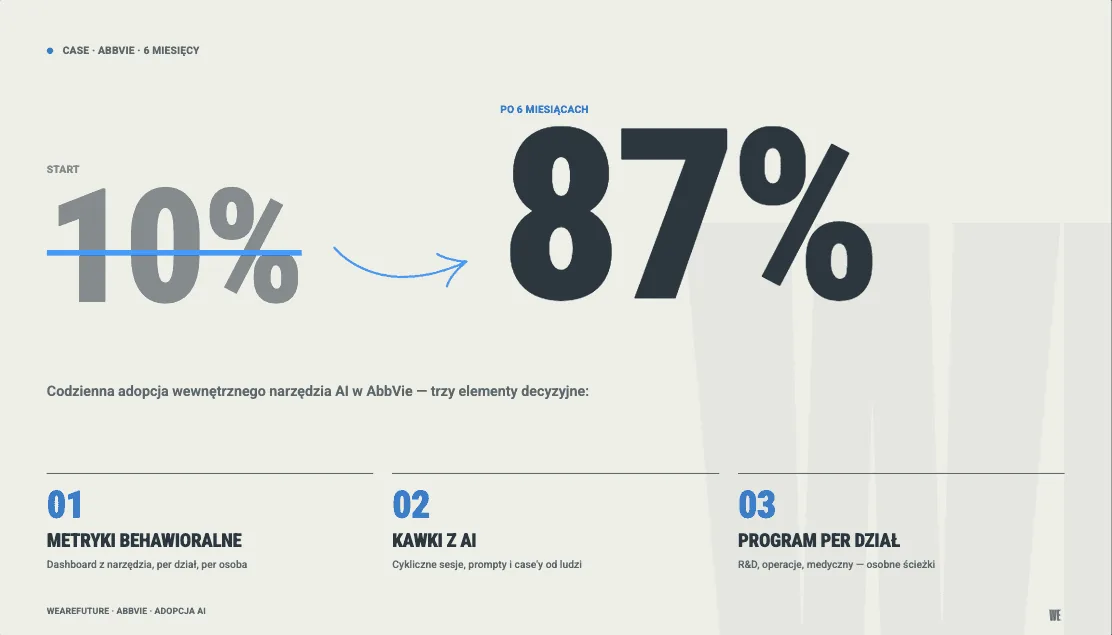
Case study: from limited use to regular use by most of the team daily adoption in 6 months
A global biopharmaceutical company started working with WeAreFuture from a level of 10% daily activity of users of an internal AI tool. After 6 months of the adoption program the indicator grew to 87%. Three elements were the key to this result:
Behavioral metrics taken directly from the tool. Modern enterprise-class solutions (Microsoft 365 Copilot, Google Gemini and most enterprise tools) provide adoption dashboards in the standard configuration. At the company we monitored the frequency and scope of use of the internal AI tool in individual departments, at the individual level.
Regular follow-up formats. Instead of one-off training, recurring sessions, the morning “AI Coffee” meetings, during which employees presented to colleagues the use cases they had discovered, the most effective prompts and worked-through scenarios. This format builds a community of AI practitioners and sustains adoption momentum far more effectively than any form of one-way communication.
Matching the program to the specifics of the department. Different content, use cases and exercises for the R&D department, different for operations, different for the medical department. Generic programs did not work in this organization, and dedicated programs turned out to be much more effective.
The success of AI adoption does not depend on the quality of a single training. It depends on whether a support structure exists alongside the training, with regular follow-up formats and an adoption dashboard, which makes it possible to identify on an ongoing basis who actually uses the tool and who needs additional support.
Investment: 2026 price ranges
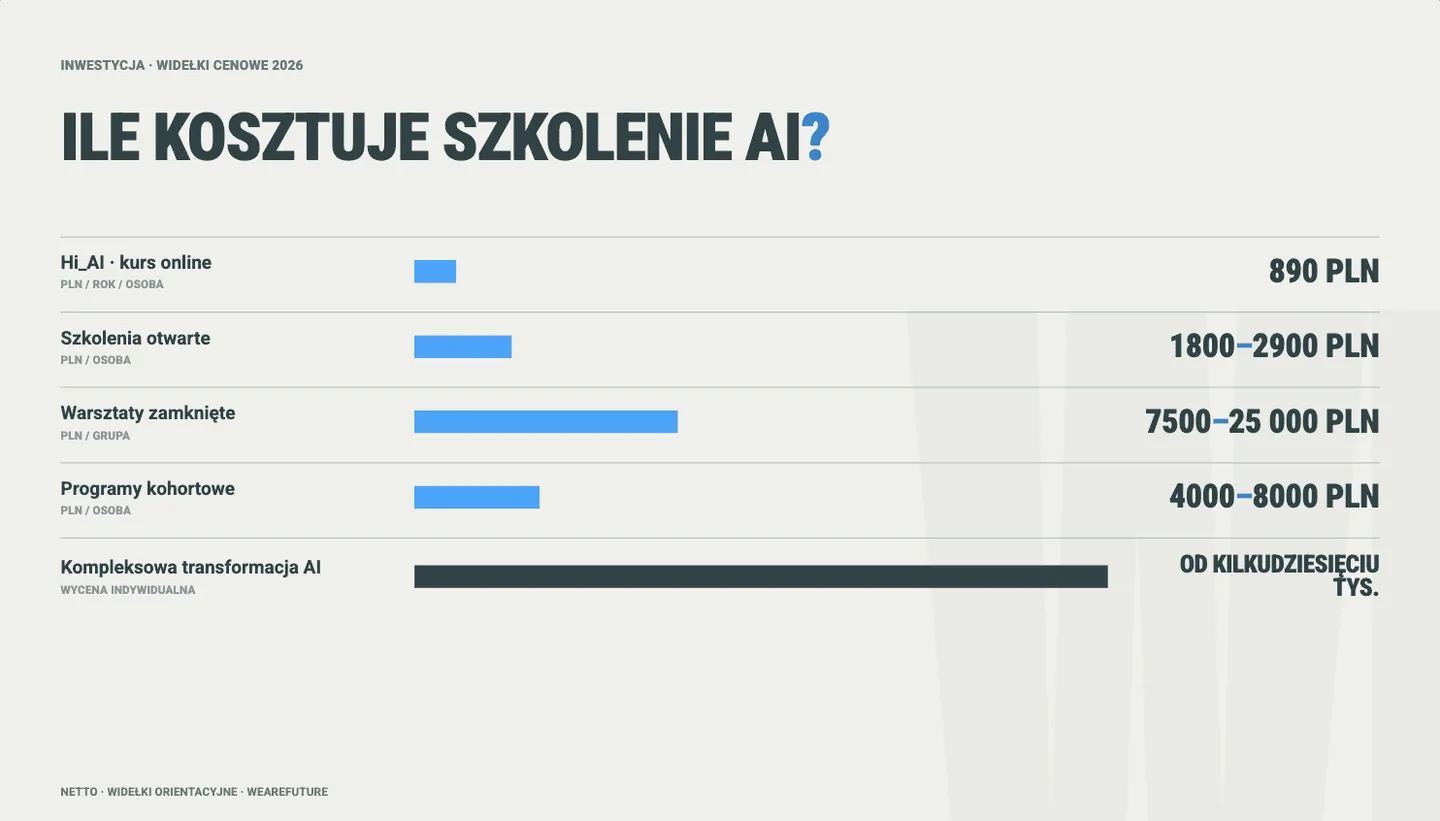
Type of training | Description | Range (net) |
|---|---|---|
Self-paced for individual employees, 8 modules, 9h | PLN 890 / year / person | |
Open training (individual) | Individual people, public courses online/in person | PLN 1,800-2,900 / person |
Closed workshops (for companies) | Dedicated to a team, matched to processes, 1-2 days | PLN 7,500-25,000 / group (up to 15-20 people) |
Multi-week / cohort programs | Workshops + mentoring + projects + final presentation | PLN 4,000-8,000 / person |
Comprehensive AI transformation | Strategy + implementation + adoption, 6+ months | Individual quote (from several dozen to several hundred thousand PLN) |
The ranges are indicative. The final quote depends on the number of workshop days, the qualifications of the trainers, the degree to which the program is matched to the organization and the scope of actions carried out after the training ends (follow-up, adoption dashboard, additional materials).
When NOT to invest in AI training
Four situations in which training will not bring the expected results, regardless of the quality of the chosen provider:
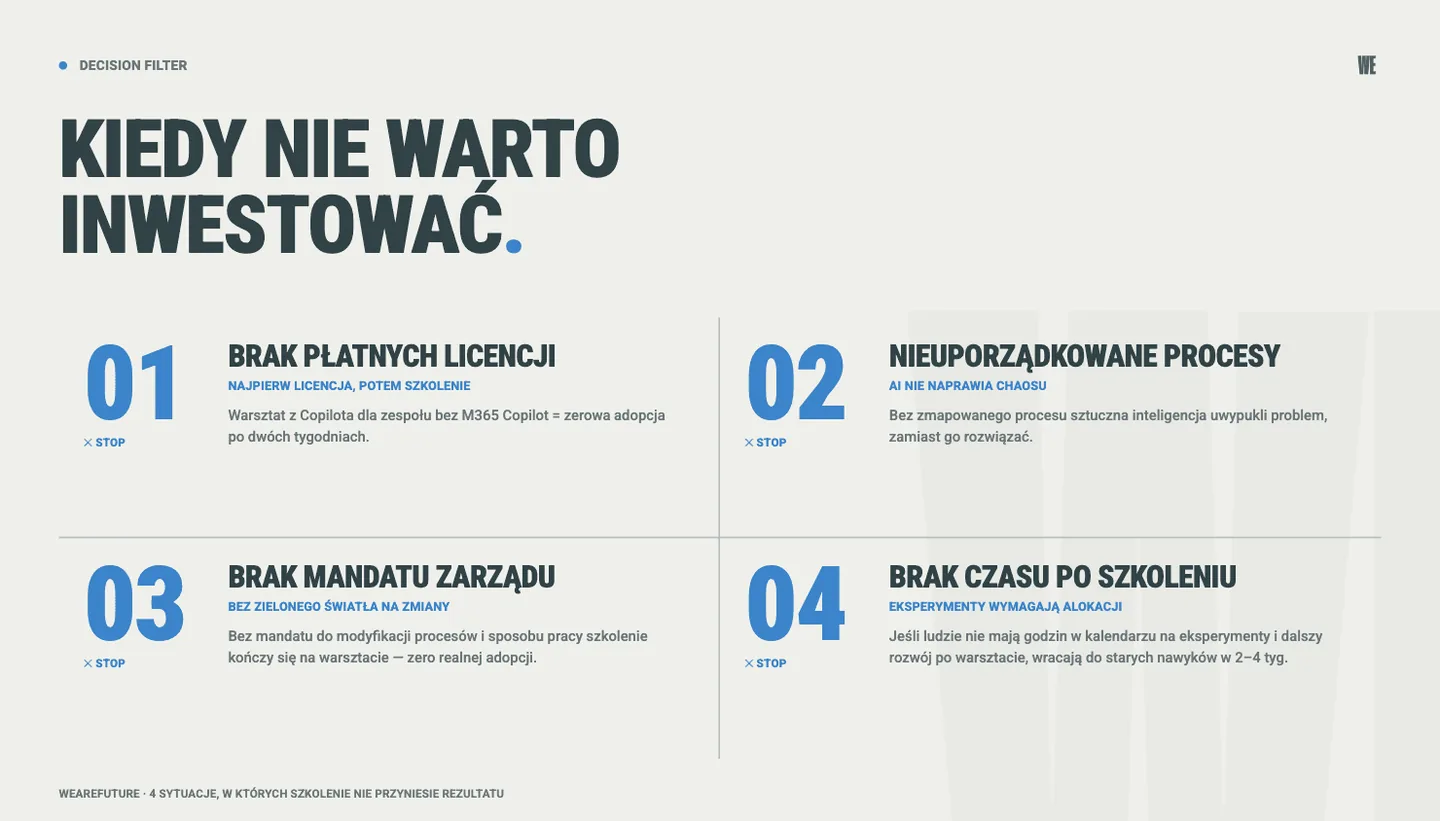
No paid licenses for the tool the training is about. Running a Copilot workshop when participants do not have access to the tool after it ends leads to zero adoption. The order should be the reverse: first the license decision, then the training.
Disorganized operational processes. If the organization has no mapped customer service process, artificial intelligence will not fix that. The first step should be putting processes in order, and only second the implementation of AI.
No sponsor at the board level. Without a person who leads the transformation from the board level, allocates budget and removes organizational barriers, adoption programs fall apart within 2-3 months.
No readiness to change the way of working. If management assumes keeping existing processes unchanged, the training program will not bring results. Implementing AI changes how work is done, not only the set of tools.
How we prepare workshops
A short version of the process by which we design dedicated company training at WeAreFuture:
Interview with the leader - we set business goals, map the current state of the organization, identify the key processes to cover.
Interviews with 3-5 operational people - we understand which tasks participants do in their daily work, where efficiency losses occur, which tools already exist in the organization.
Use case mapping - we identify the areas in which implementing AI generates measurable ROI in the conditions of the given organization.
Designing the agenda for specific needs - thematic blocks, exercises and materials are built on the mapped use cases.
Running the workshop - most often in a one- or two-day format, intensively, on the client’s data or their safe equivalents.
Follow-up - regular knowledge-sharing sessions, an adoption dashboard, supplementary consultations for at least 3 months.
Without an in-depth interview at the start of the process and a structured follow-up after it ends, training remains a one-off event. With these elements it becomes a lasting change in how the organization works.
What next
For organizations ready for a transformation that goes beyond individual training, covering AI strategy, governance, implementations and adoption in one program, we refer you to the description of our collaboration model for AI transformation. In it we build the AI Engine, a shared company context used by people and agents, in stages, process by process.
The simplest next step is to identify where the organization is at the moment. In the inspiration phase it is not worth jumping straight into a cohort program. With organized processes and licenses already purchased, it is not worth investing in another inspiration session. A more effective step is to move to an adoption or specialized workshop.
If you have doubts about where your organization is and what type of training it needs, we are happy to talk. No generic offer, based on the specific context of your company.
Training is the start. The full picture is given by the guide to AI implementations: architecture, costs, stages.
FAQ: the most common questions about AI training for companies
How long does AI training for a company take?
It depends on the type of program. An inspiration session is 2-6 hours. A specialized workshop is 1-2 days. Adoption training runs from half a day (a short introduction to a specific tool) to 2 days (in-depth onboarding). Cohort programs stretch over 3-6 months with regular sessions every 2-3 weeks. An offer of “AI training for a company in 90 minutes” is not a full training but a demonstration presentation.
Can AI training for companies be subsidized?
Yes. In Poland the following are available: Poland’s National Training Fund (KFS), which covers up to 70% of training costs; Poland’s Development Services Database (BUR) with PARP co-funding, especially for SMEs; and European funds under FERS (European Funds for Social Development), where the “Competencies from Automation” program reaches 83%. Organizations recover 50-83% of training costs, depending on company size and the chosen source of funding. KFS rates have applied since 1 January 2026 under the Act on the Labor Market and Employment Services. We are happy to help if you have doubts about subsidized training.
We laid out the paths, rates and limits in the guide to funding for AI implementation.
In person or online: which to choose?
Inspiration training and adoption training on a specific tool work well online, especially for distributed teams. Specialized workshops, during which we map processes and design use cases, are best run in person. Group work at a whiteboard, the dynamics of the room and networking between participants are values that are hard to reproduce in a remote format.
When do the effects of AI training become visible?
The first wave of adoption is visible 2-4 weeks after the training (who regularly reaches for the tool). Stable adoption takes 2-3 months. Measurable ROI in the form of time saved, better decisions and increased productivity takes 3-6 months. For this reason, evaluating effectiveness right after the training (a satisfaction survey) does not provide valuable information. Measurement should be done on a quarterly cycle, based on tool usage metrics.
How do AI trainings for companies differ from general online courses (Coursera, Udemy)?
An online course teaches how to operate a tool. Company training teaches how to use the tool in a specific process of the organization. A course delivers theoretical knowledge that each participant works through alone. Training is work on the organization’s specific use cases with a mentor. A course costs PLN 100-500 per person and requires discipline: research shows about 10% of buyers finish it. Company training is characterized by a higher cost, but it delivers measurable adoption. Both have their uses, but as complements, not substitutes. For individual employees we also have our Hi_AI course: 9 hours of recordings, 1000+ participants.
For how many people should the training be organized?
A dedicated workshop: 8-15 people (above that number it is hard to maintain the dynamics and individual work with each participant). Inspiration sessions: up to 30-50 people (a lecture format with a Q&A session). Cohort programs: cohorts of 12-25 people. For an organization covering 200+ employees with training, the optimal approach is to split into cohorts by department. A generic training for everyone at once does not deliver results.
Will AI training replace employees in the company?
No. AI training makes the same employees do their work faster and more effectively. The change observed at clients: savings of 5-15 hours a week per person on administrative, reporting and analytical tasks. This time is moved to higher-value tasks: strategic, creative and those tied to direct customer service. It is not a reduction of headcount but a redistribution of working time.
Do we need an in-house AI specialist to get started?
Not at the stage of the first training. It is enough to have a sponsor at the board level on the organization’s side and one or two people acting as AI Champions (they can come from any department, being a technical expert is not required). An in-house AI specialist becomes necessary when the organization moves into implementing its own AI agents, process automation and dedicated integrations - that is already a stage of transformation, not of training.
Sources:
See also: [Claude adoption in a Polish manufacturing company]
