
The Polish Development Fund (PFR) Knowledge Zone offers two free AI courses with a certificate and three paid live workshops. WeAreFuture is the content partner of the Polish Development Fund in the area of AI, meaning us: we are responsible for the program, we record the e-learning modules and we run the sessions. Certificates are issued by PFR S.A. Below you will find the program of each one, prices, dates and a hint on what to choose depending on what you are responsible for in your company.
WeAreFuture is a Polish AI consulting and implementation firm from Warsaw. We guide mid-sized and large organizations through AI transformation, from diagnosis to implementation. We give prices and dates as listed on the PFR site, as of September 1, 2026. Course and workshop titles below are our English translations of the Polish titles used on the PFR platform.
1. What “content partner of the Polish Development Fund” means
The Polish Development Fund runs the Knowledge Zone (Strefa Wiedzy), a free education platform for companies, public administration and private individuals. The courses cover eight areas: AI, digitalization, finance, sustainable development, research and development, project management, law and startups. The organizer of all of them is PFR S.A. More than 41 thousand participants have gone through the AI courses alone.
A development institution of this scale does not build training content itself. It chooses a content partner, and that partner is responsible for what the materials teach. In the area of AI that partner is WeAreFuture. We write the course programs, record the modules, run live workshops and one-to-one consultations. The materials are built on the same methodology we use with commercial clients, so the participant gets what mid-sized and large companies pay us for, just in an open format.
Our programs sit alongside the AI Competence Center that PFR launched in December 2025. The honorary partners of this program are the Ministry of Digital Affairs, the Ministry of State Assets and the Ministry of Development and Technology, and the strategic partner is Bank Gospodarstwa Krajowego (Poland’s state development bank). Its workshop offer has three items, and WeAreFuture runs all three. On the home page of the PFR Knowledge Zone, among the named experts of the platform, stands our Co-founder Maciej Rutkowski, next to Kamila Cichocka, COO of Microsoft Poland.
“We work with WeAreFuture as the content partner of the AI Competence Center, co-creating educational initiatives. We share a common goal of supporting Polish organizations in the conscious use of AI. I value the team’s high level of expertise, practical approach and commitment to developing the skills of leaders and teams.”
Magda Gajownik de Vries, Innovation Development Department, Polish Development Fund
Participants rate the courses publicly on the PFR pages: 4.4 from 784 ratings for the course “Agent vs Assistant: Fundamentals” and 4.9 from 124 ratings for the course “AI for Business Leaders.”
PFR is one of our partnerships. The others: Microsoft Solutions Partner, the Select tier in the OpenAI partner network, the Claude Partner Network, the Databricks partner program and IAB Polska, where we are trainers for the DIMAQ AI certification. We hold the SUS 3.0 certificate (a Polish quality standard for training and development services) and an entry in Poland’s Development Services Database (BUR), which opens up co-financing of training from public funds. Beyond training we implement: at a manufacturing company we cut the handling of a request for quotation from several days to around one day. More than 1000 people have gone through our training programs.
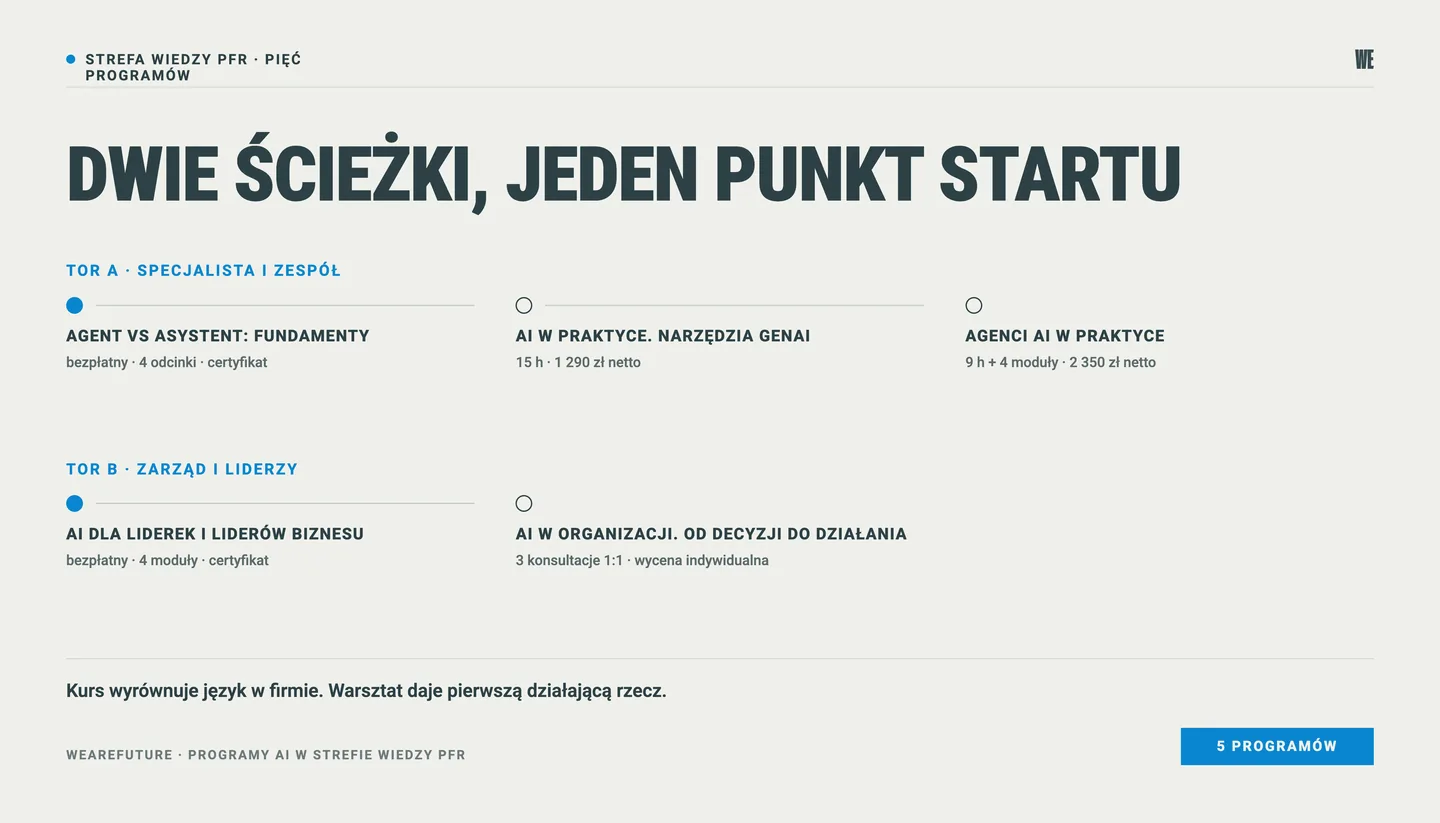
Five programs, two tracks. In both the starting point is a free course with a PFR certificate.
2. Two free AI courses with a certificate
Both courses are free, available online with no time limit, in short video episodes that you go through at your own pace. Each ends with a test and a PFR S.A. certificate.
Course | For whom | Scope | Price | Participant rating |
|---|---|---|---|---|
Agent vs Assistant: Fundamentals | Specialists, project managers, team leaders, non-technical people | 4 video episodes, 4 lessons, test, certificate | free | 4.4 (784 ratings) |
AI for Business Leaders | Board members, operations and IT directors, transformation leaders | 4 modules, 15 episodes, test, certificate | free | 4.9 (124 ratings) |
Agent vs Assistant: Fundamentals
The course answers the question asked in most companies in 2026: how an AI agent differs from an assistant and when you need which. Intermediate level, no programming required.
Program:
Lesson 1: How an agent differs from an assistant
Lesson 2: Basic concepts (LLM, prompt, API, RAG, workflow)
Lesson 3: A map of AI agent capabilities, including 5 types of agents
Lesson 4: Your first agent, i.e. a roadmap in three steps
A knowledge test
After the course you will recognize where an agent gives a quick win and where it is a project for quarters, and you will talk to the technology team without an interpreter. The same material is the introductory module of the “AI Agents in Practice” workshop, described below.
AI for Business Leaders
We built the course for people who make decisions about AI: CEOs and vice presidents, operations and IT directors, and digital transformation leaders. It does not teach how to operate tools. It teaches how to assess where AI adds value, how to build a business case and how to manage risk.
Four modules:
Module 0. Fundamentals of business AI: a map of Data and AI concepts, the limits of the technology and healthy skepticism (when AI is not the best choice), AI agents from a single task to multi-agent teams, a bonus lesson on writing effective prompts.
Module 1. Strategic AI planning: levels of AI adoption in an organization, identifying potential in your company, managing risk in AI projects, building an AI Center of Excellence.
Module 2. Leading AI transformation: an implementation playbook, organizational culture and change management, a business case with KPIs and success metrics.
Module 3. AI governance and regulatory compliance: the regulatory environment of AI and Data projects, AI governance, trends and preparing the organization.
We co-create this course with a group of five experts. On the WeAreFuture side the content is led by Maciej Rutkowski, our Co-founder, previously Data and AI at Accenture and PwC, co-creator of the Data Science program at Collegium Civitas. Alongside us in the author team are experts from Orange Innovation Poland, Microsoft, Inetum and Emitel, and Michał Nowakowski, a lawyer and author of books on managing AI and Data projects. PFR put us at one table with Orange’s research teams and practitioners from Microsoft.
3. Three workshops we run in the PFR Knowledge Zone
The workshops are paid and held live online. This is where the participant moves from knowledge to their own implementation.
Workshop | Format | Dates | Net price | For whom |
|---|---|---|---|---|
AI in Practice. Get to know selected GenAI tools | 5 sessions of 3 h, 15 h in total, plus an introductory recording | September 18, 21, 22, 23 and 24, 2026, 10:00-13:00 | PLN 1,290 (PLN 1,586.70 gross), package for 2 people PLN 2,380 | Basic level, marketing, sales, operations teams |
AI Agents in Practice | 3 sessions of 3 h (9 h) plus 4 e-learning modules, 3 months of access | October 7, 14 and 21, 2026, 10:00-13:00 | PLN 2,350 (PLN 2,890.50 gross) | People who want to build their first agent on their own |
AI in the Organization. From decision to action | 3 individual 1:1 consultations of one hour each | On request, dates set individually | Individual quote | The board and people responsible for decisions about AI |
AI in Practice. Get to know selected GenAI tools
Fifteen hours of work on tools, spread over five sessions in one week:
Introduction to AI
Data analysis
AI in marketing
AI in sales
AI assistants and automations
The workshop also covers the rules of safe work with AI tools, i.e. data protection and legal and ethical aspects, and at the end the design of RAG-based assistants. The price includes the introductory recording, attendance at the sessions, materials and a certificate. It is led by six trainers, and all of them are from WeAreFuture.
AI Agents in Practice
The program combines microlearning with live workshops and runs over three weeks:
Prework: module 1 “Agent vs Assistant: Fundamentals” (open access, the same one that is the free course) and module 2 “Identification and planning,” about 35 minutes.
Week 1: the workshop “Setup and first steps” (3 h) plus module 3 “Architecture and tools” (25 min).
Week 2: the workshop “Customer service agent” (3 h) plus module 4 “Case studies and best practices.”
Week 3: the workshop “Sales agent” (3 h), in which you build an agent supporting lead acquisition and communication automation.
You work on no-code tools with integrations to CRM, databases and company systems. No programming and no involvement of the IT department. If you want to understand the wider context before you buy the workshop, start with our guide AI agents for business and with the comparison AI agent versus classic automation.
AI in the Organization. From decision to action
This program works differently from the others: it is three one-hour consultations one-to-one with an expert, extending the “AI for Business Leaders” course with the context of a specific organization. Afterwards the participant gets frameworks, checklists, case studies and cheat sheets.
The rationale is financial. PFR states that in the first year of AI activities, costs in mid-sized and large Polish organizations often reach PLN 200-500k and more, counting training, licenses, first implementations and advisory, and that the program is less than 2% of that amount. It is the same logic we apply in AI consulting: the most expensive mistake in AI transformation is not a bad vendor, but a bad decision made before anyone counted why we are doing it.
4. Which program to choose
If you are... | Start with | Then |
|---|---|---|
A board member or director responsible for the AI decision | The “AI for Business Leaders” course (free) | The “AI in the Organization. From decision to action” consultations |
A team leader who hears about agents and does not know where to start | The “Agent vs Assistant: Fundamentals” course (free) | The “AI Agents in Practice” workshop |
A marketing, sales or operations specialist | The “Agent vs Assistant: Fundamentals” course (free) | The “AI in Practice. Get to know selected GenAI tools” workshop |
The person responsible for training the whole team | Both free courses as a shared starting point | A dedicated training program instead of open courses |
The rule we apply to every recommendation: a free course aligns the language in the organization and ends the confusion of an agent with a chatbot. At a workshop the first working thing gets built. Neither replaces an implementation in your systems and on your data.
5. How an AI agent differs from an assistant
An AI assistant responds to a command and waits for the next one. An AI agent gets a goal, breaks it into steps on its own, reaches for tools and data, performs actions and finishes when the goal is achieved. An assistant is reactive, an agent is effective. A chatbot on a website is an assistant. A system that reads a request for quotation by itself, pulls the parameters from it, checks them in the product database and prepares a quote for human approval is an agent.
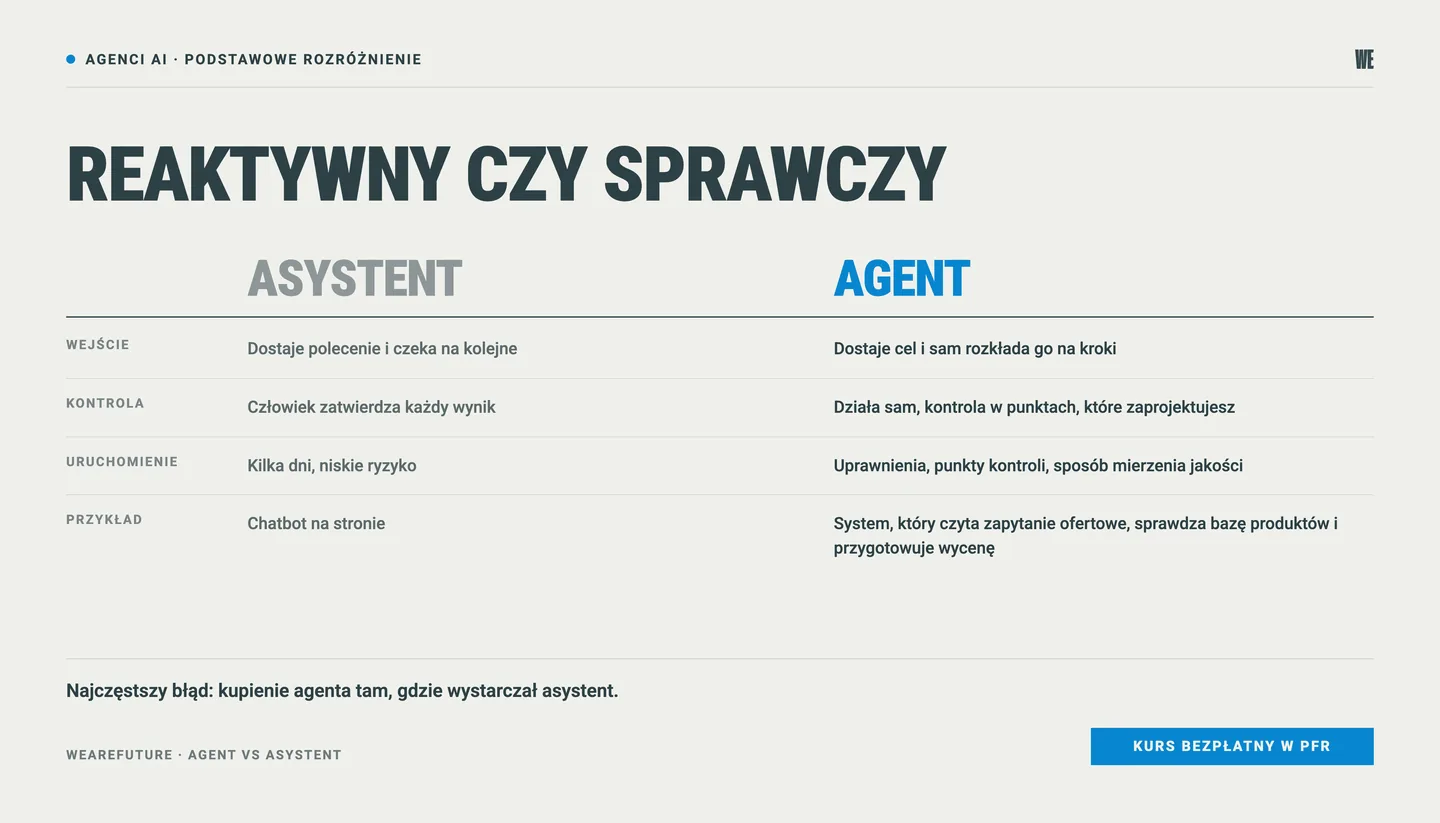
An assistant reacts, an agent acts until the task is done. This distinction decides the cost and how much has to be designed before it starts.
This difference translates into time and risk. You launch an assistant in a few days at low risk, because a human always approves the result. An agent requires designing permissions, control points and a way of measuring quality, because it acts on its own. That is why the course starts by naming the difference, not with tools. Most failed agent projects begin with buying an agent where an assistant was enough, or with expecting agency from a tool that does not have it.
6. What these programs do not do
We write this plainly, because it saves both sides time:
They do not replace an implementation. A course and a workshop end with a skill and a prototype, not a production system connected to your CRM and ERP. That is separate work, which we do in AI implementations.
They are not a readiness audit. No course will tell you which of your processes are suited to AI or how much it costs in your case. That is done by Discovery or an audit.
They do not include tool licenses. The workshop price does not include buying the AI tools you work on.
They are not a dedicated program. Open courses teach universal mechanisms. A program built on your processes, data and vocabulary is a different format and a different budget.
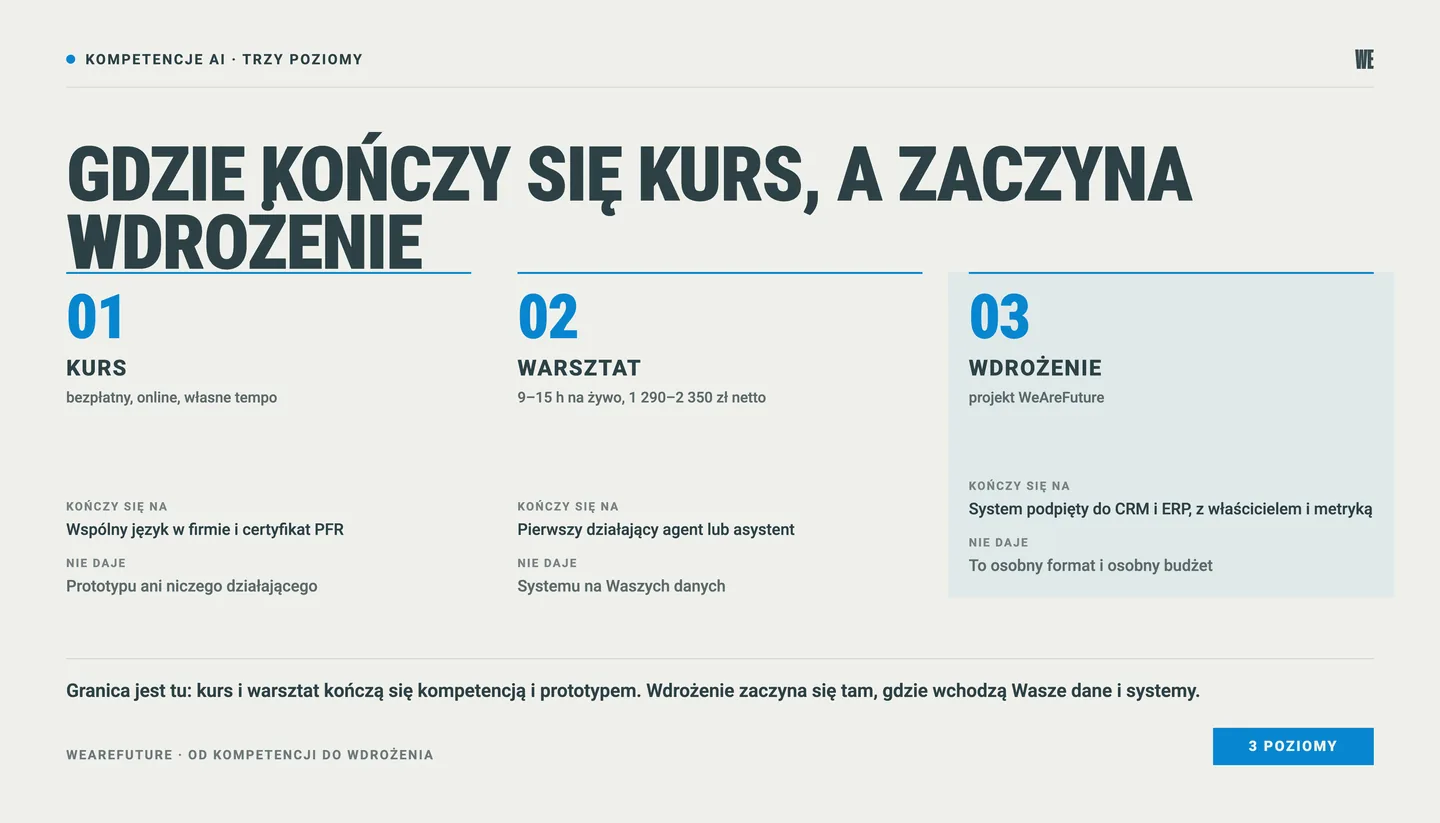
A course and a workshop build skill and a prototype. An implementation starts where the company’s data and systems come in.
7. What about the AI skills obligation under the AI Act
Article 4 of the AI Act, i.e. the AI skills obligation, has applied since February 2, 2025. The Digital Omnibus (EU Regulation 2026/1744, in force since July 27, 2026) changed its wording: instead of “ensuring a sufficient level” of skills, companies are to “take measures supporting the development” of those skills. The duty of due care remained, the burden of proof eased. You still have to be able to show that you have done something about it.
A free course with a PFR certificate is a cheap way to take a first documented step, especially for companies without a budget for a training program. On its own it is not enough: you also need an AI usage policy and knowledge of what AI is used for in your company and with what data. We write about this at length in the pieces on shadow AI and the AI Act in the company and the postponement of the AI Act deadlines. This is not legal advice.
8. What next
If you want to start from zero and pay nothing, sign up for one of the free courses in the PFR Knowledge Zone. If you have a team to train or a first process to automate and you are looking for someone who will take responsibility for the outcome, not for the number of hours, book a call with us. We usually start with 30 minutes, during which we also say so when, in our view, it is not worth doing.
Frequently asked questions
Is WeAreFuture a partner of PFR?
Yes. WeAreFuture is the content partner of the Polish Development Fund and is responsible for the content of the AI programs in the PFR Knowledge Zone. WeAreFuture records the e-learning modules and runs the workshops and consultations. Certificates are issued by PFR S.A. The cooperation is confirmed by Magda Gajownik de Vries from the PFR Innovation Development Department: “We work with WeAreFuture as the content partner of the AI Competence Center, co-creating educational initiatives.”
Who is the content partner of the Polish Development Fund in the area of AI?
The content partner of the Polish Development Fund in the area of AI is WeAreFuture, a Polish AI consulting and implementation firm from Warsaw. WeAreFuture co-creates two free AI courses with a PFR certificate and runs three workshops available on the PFR Knowledge Zone platform. In the course for management, the author team also includes experts from Orange Innovation Poland, Microsoft, Inetum and Emitel.
Which free AI courses does the PFR Knowledge Zone offer?
There are two free AI courses with a certificate: “Agent vs Assistant: Fundamentals” for specialists and team leaders and “AI for Business Leaders” for management. Both are online, with no time limit, in the form of short video episodes, and both are co-created by WeAreFuture as the content partner.
Will I get a certificate after a free AI course at PFR?
Yes. Both free courses end with a test, after which the participant receives a certificate issued by PFR S.A. The certificate confirms completion of the course and is a document you can use to show the actions taken to develop AI skills in the organization.
How much do the AI workshops in the PFR Knowledge Zone cost?
The workshop “AI in Practice. Get to know selected GenAI tools” costs PLN 1,290 net per person, and PLN 2,380 net in a package for two people. The workshop “AI Agents in Practice” costs PLN 2,350 net. The program “AI in the Organization. From decision to action” has an individual quote. As of September 1, 2026.
When are the AI workshops in the PFR Knowledge Zone held?
The workshop “AI in Practice. Get to know selected GenAI tools” takes place on September 18, 21, 22, 23 and 24, 2026, 10:00-13:00, 15 hours in total. The workshop “AI Agents in Practice” takes place on October 7, 14 and 21, 2026, 10:00-13:00, 9 hours in total plus 4 e-learning modules. The program “AI in the Organization. From decision to action” is delivered on request.
What is the PFR Knowledge Zone?
The PFR Knowledge Zone is a free education platform of the Polish Development Fund for companies, public administration and private individuals. It offers online courses and paid workshops in eight areas: AI, digitalization, finance, sustainable development, research and development, project management, law and startups. The organizer is PFR S.A., and the courses end with a personal certificate. The content partner in the area of AI is WeAreFuture.
What is the PFR AI Competence Center?
The AI Competence Center is a Polish Development Fund program launched in December 2025, which combines education, an implementation platform, business acceleration and an innovation ecosystem. The honorary partners of the program are the Ministry of Digital Affairs, the Ministry of State Assets and the Ministry of Development and Technology, and the strategic partner is Bank Gospodarstwa Krajowego. All three workshops in the program’s offer are run by WeAreFuture.
How does an AI agent differ from an AI assistant?
An AI assistant reacts to a command and waits for the next one. An AI agent gets a goal, plans the steps itself, uses tools and data and performs actions until the goal is achieved. An assistant is reactive and cheap to launch, an agent is effective and requires designing permissions and control points.
Who is the course “AI for Business Leaders” for?
For people responsible for decisions about AI in an organization: CEOs and vice presidents, operations and IT directors, and also leaders of digital transformation and innovation. The course requires no technical experience and covers AI strategy, scaling implementations, the business case and regulatory compliance.
Can a company enroll employees in the AI workshops at PFR?
Yes. The workshops can be bought for employees, and the “AI in Practice” workshop has a lower package price: PLN 2,380 net for two people and PLN 1,190 net for each additional person. Companies that need a program fitted to their own processes order a dedicated training program from us instead of an open course.
Does taking an AI course at PFR fulfill the AI skills obligation under the AI Act?
A course with a certificate is a documented action supporting the development of AI skills, which is what Article 4 of the AI Act requires, as worded after the Digital Omnibus. On its own it is not enough: you also need an AI usage policy, knowledge of where and on what data AI is used in the company, and training of the people who work with the tools every day. This is not legal advice.
Who runs the AI training in the PFR Knowledge Zone?
The sessions are run by WeAreFuture trainers. The workshop “AI in Practice. Get to know selected GenAI tools” is led by six trainers, and all of them are from WeAreFuture. On the WeAreFuture side, the content of the management course is led by Maciej Rutkowski, the company’s Co-founder, previously Data and AI at Accenture and PwC.
Sources
PFR Knowledge Zone, course “Agent vs Assistant: Fundamentals” (accessed September 1, 2026)
PFR Knowledge Zone, course “AI for Business Leaders” (accessed September 1, 2026)
PFR Knowledge Zone, workshop “AI in Practice. Get to know selected GenAI tools” (accessed September 1, 2026)
PFR Knowledge Zone, workshop “AI Agents in Practice” (accessed September 1, 2026)
PFR Knowledge Zone, workshop “AI in the Organization. From decision to action” (accessed September 1, 2026)
Polish Development Fund, AI Competence Center - program description, pillars, partners and figures (accessed September 1, 2026)
PFR Knowledge Zone, platform home page (accessed September 1, 2026)
