
AI training for the whole company, not just for selected teams, works best as an ambassador program. An AI ambassador program is an adoption model in which we go deeper into workshop work with a smaller group of employees, learn about their daily challenges and, on that basis, teach them to work with AI tools in depth. The group then passes this knowledge on across the organization, department by department, and works with us to find improvement opportunities in their teams. In large, international manufacturing companies this is one of the few methods that reliably turns purchased licenses into daily use, as long as the program survives the first months of resistance.
WeAreFuture is a Polish AI consulting and implementation firm based in Warsaw. Since mid-2025 we have been running such a program at an international manufacturing company with more than 2,200 employees across many European countries. The starting point: the company has had an AI use policy since the start of the program, one item on the list of approved tools and varying levels of AI skills among employees.
In this article: how we designed an ambassador program for an organization operating in many countries, which moments showed that the training was starting to work, why one hard adoption number does not replace full measurement and why access to different AI tools is key during the program.
Buying licenses, training, and six months later doubt about whether the investment made sense: this is a common scenario in large organizations at the start of an AI transformation. If that is where you are, let's talk about an AI adoption program tailored to your organization: 30 minutes, no commitment.
Two boundary conditions we had to account for from day one
The shape of the program is determined by two characteristics of the organization: geographic spread (many countries, different languages and local regulations) and strong pressure from the security team (tool whitelisting, concerns about GDPR and data transfers outside the EU).
How we designed an ambassador program for an organization in many countries
The program opened with a kick-off attended by the group's board. The CEO personally presented the goals of the initiative to senior management, which from day one gave the topic a weight that an email from HR or an external education partner cannot achieve. A week later there was a second, in-person kick-off for the ambassador group, at the headquarters of one of the group's companies, with local management present.
The ambassador group was built through open self-nomination, complemented by reaching out directly to people from different countries and departments: not only IT or marketing, but also production, finance and sales. A cross-functional group is key. An ambassador from production understands different problems than an ambassador from finance, and the program only makes sense when every department has its representative.
The program schedule rests on three parallel tracks:
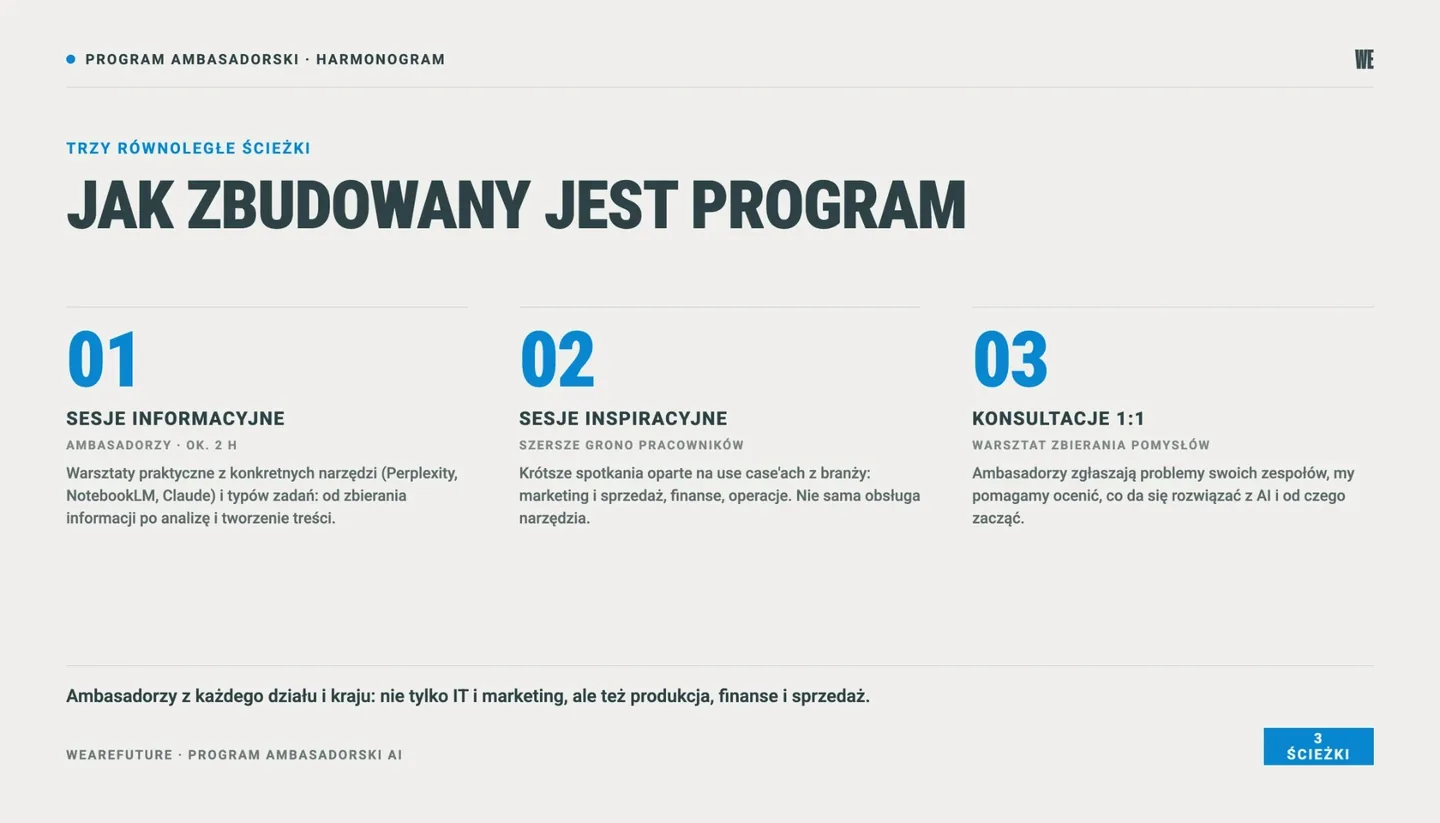
Information sessions: regular, roughly two-hour hands-on workshops on specific tools (for example Perplexity, NotebookLM, Claude) and types of tasks: from gathering information, through cleaning up inconsistent data, to analysis and content creation.
Inspiration sessions: shorter meetings for a wider group of employees, based on use cases from the industry (marketing and sales, finance, operations), not just on how to operate the tool.
1:1 consultations and an idea-gathering workshop: looking for improvement opportunities in departments. Ambassadors bring problems from their teams' daily work, and we help assess which can be solved with AI and where to start. They learn on their own processes, not on artificial examples.
We described the bigger picture of how to match the format and scope of training to an organization in our guide to AI training for business. If you are wondering which tool to choose as the foundation of such a program, we wrote about it in our comparison Claude vs ChatGPT, Copilot and Gemini for business. In our practice, the answer depends on the type of tasks in the organization, not on one universal ranking.
The moments when it was clear it was starting to work
The strongest argument for ambassadors is not benchmarks or AI news, but moments in sessions when participants see live what the tool can do today. In one session on cleaning up data, participants worked on a set of numbers with deliberately introduced errors: transposed digits in several entries. The tool detected these discrepancies on its own. The session lead noted that the same exercise simply failed six months earlier, and today it works without difficulty. This is proof of how fast the technology is developing, and for workshop participants a vivid argument and extra motivation to build their skills.
A similar pattern appeared in work with financial data. In one of the controlling teams, an employee built a solution on their own that automated a large part of the reporting work. The effect was visible enough that the rest of the team began to talk openly about the need to catch up on skills so as not to “fall out of the loop”. This is the organic, bottom-up adoption signal we look for in our programs, stronger than any statement in a survey.
We also heard about a difference in quality between tools on the same type of task. One of the program leads on the client side built a dashboard and a presentation from the same raw data in two different tools and got clearly different results. A signal like this from one person's daily practice is a better reference for the people around her than rankings or slides: the choice of tool depends on the type of task and the data a given team works with.
Program results: active Copilot users from 33% to 49%
From the Copilot admin panel we have one measured, not self-reported, indicator: the share of active users (at least 8 days of activity per month or more than 50 prompts per month) grew from 33% to 49% in the first months of the program. That is an increase of 16 percentage points, measured hard, not by participants' self-assessment.
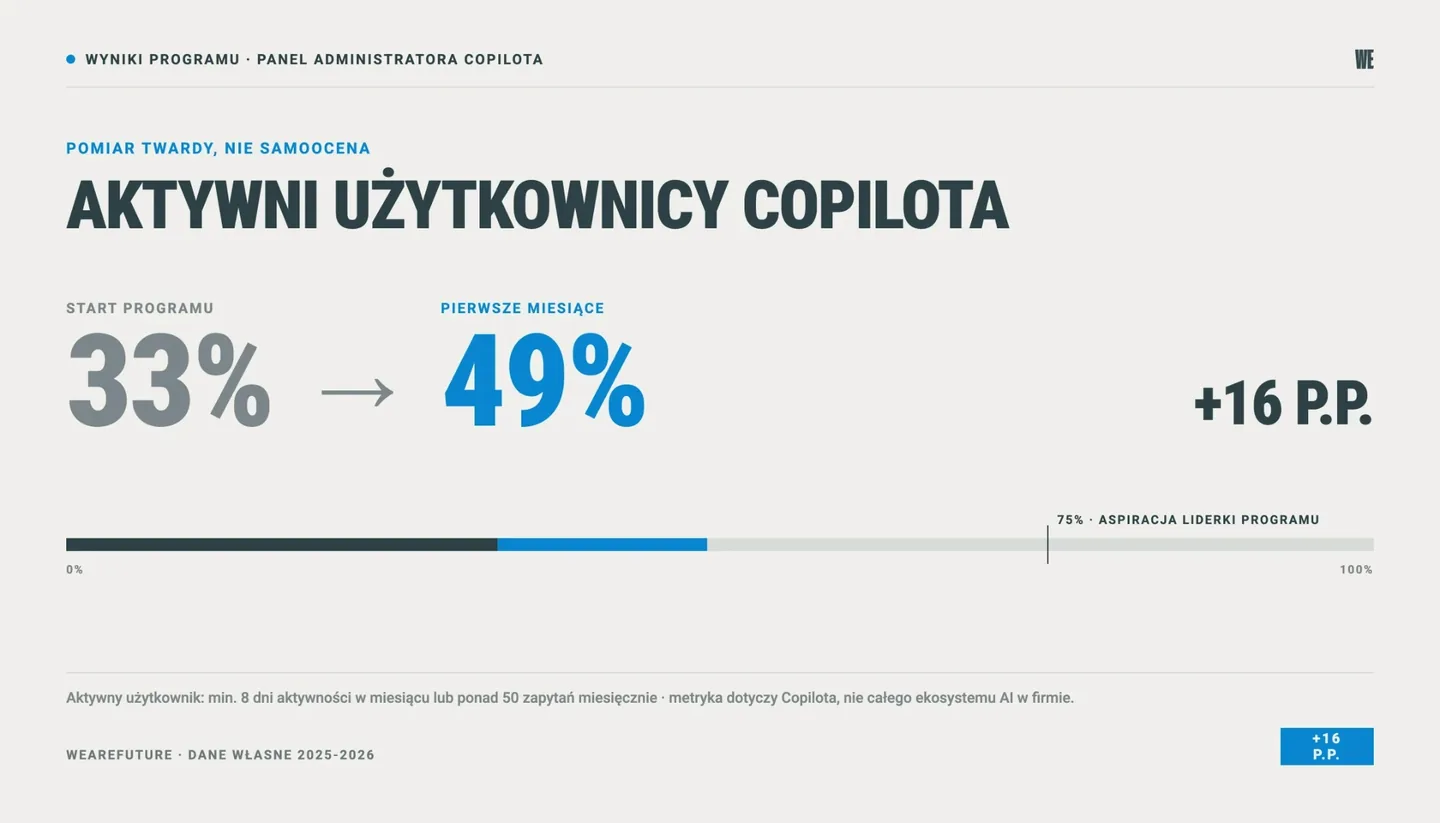
We also have to say honestly what this number does not show. One of the program leads said openly that she would be satisfied if at least 75% of license holders used it regularly. This is an informal aspiration, not an official target of the organization, but it shows the gap well: at this stage, more than half of license holders still do not use the tool regularly. The metric is about Copilot, not the company's whole ecosystem of AI tools. And most important methodologically: it is a single indicator from a single source.
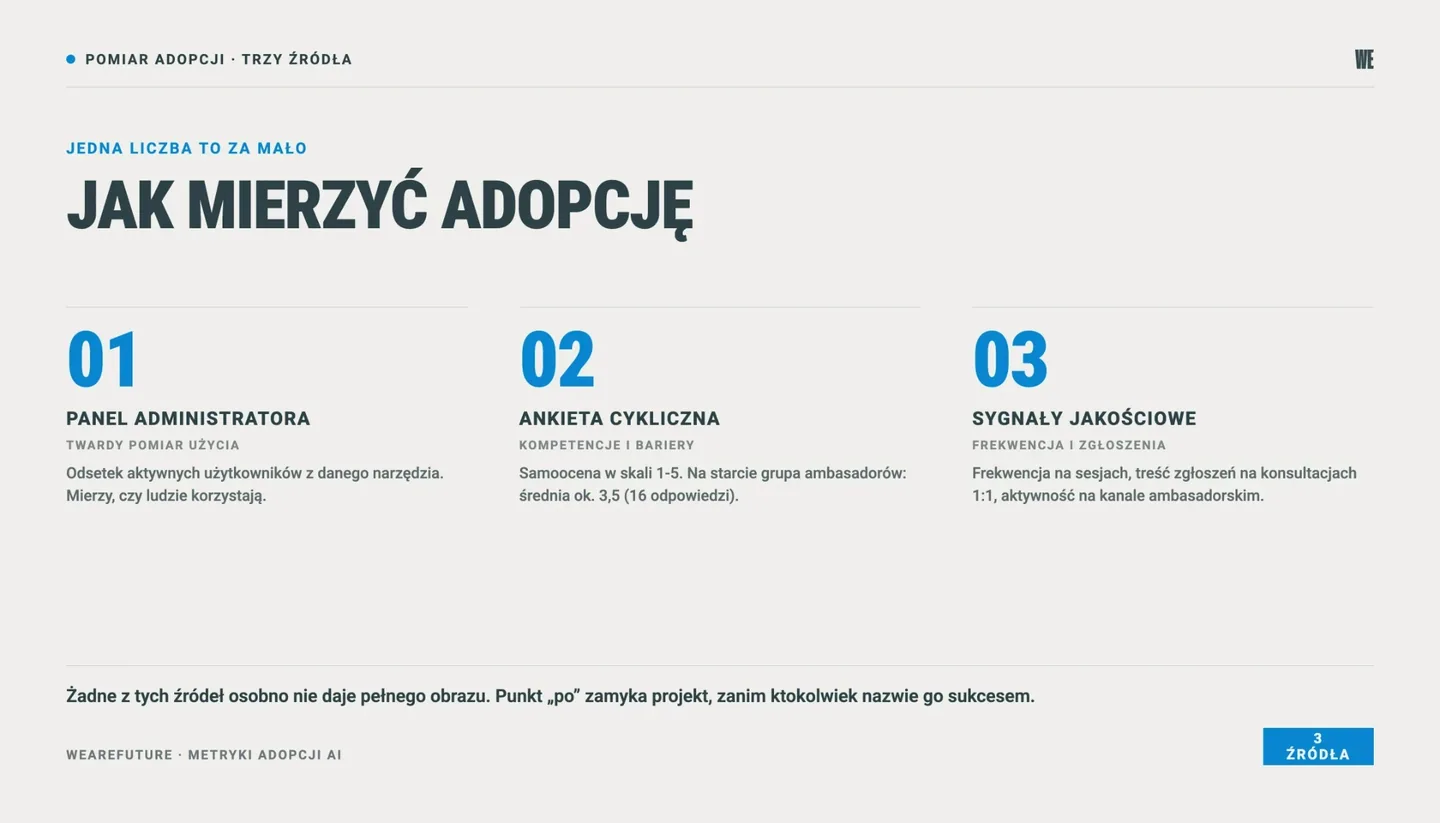
No single metric, even one measured hard, gives a full picture of adoption. You need three sources in parallel: the admin panel (hard measurement of usage), a recurring survey (self-assessment of skills and barriers) and qualitative signals: session attendance, the content of requests in 1:1 consultations, activity on the ambassador channel. We described the full set of indicators in our article on AI adoption metrics in the company. In this program we have a solid “before” point: an initial survey of the ambassador group at the start (16 responses, self-assessment on a 1-5 scale) with an average AI skill level of around 3.5. We don't have the “after” point yet. This is one of the things still to be done, and it should close every such project before anyone calls it a success.
Time saved is not the only measure, and often not the most important one. What matters more is the value employees start to create when they have tools that change the way they work: solutions that previously did not get built at all, faster answers for customers, less backlog in the queue. The percentage of active users alone will not capture that.
Where resistance comes from and why tool decisions change during the program
An honest case study also has to show what did not go smoothly. During the program a cost debate came up: access to one of the AI models through the existing Microsoft infrastructure turned out, according to the client's estimates, to be clearly more expensive than a license directly from the vendor. On top of that came questions about GDPR compliance for data transfers outside the European Union. The result: a decision to pause extending access to this tool until the licensing situation is clarified.
This is not a failure of the program, but a decision that comes up during every AI transformation in an organization of this scale. Companies with strict data security requirements return to the topic of costs and server location many times, not only at the start of a project.
There were also more mundane difficulties, typical of programs that stretch over many months: delays in ambassadors submitting ideas, falling attendance at some sessions in the summer months, a change of trainer during the program. None of these alone is a drama, but together they show that an adoption program in a large organization rarely runs in a straight line. Boards rarely question individual stumbles. Much more often they question reporting that does not show such stumbles at all.
The key lesson from this stage: without a sponsor who regularly reminds people about the program and gently holds their direct reports accountable for it, engagement drops much faster than in programs with clear managerial accountability. Market data confirms this: according to the BCG AI at Work 2025 study, the share of employees positive about GenAI rises from 15% to 55% when they feel strong support from leaders, yet only about a quarter of frontline employees report such support. As one of the people coordinating the program on the client side put it: as long as nobody holds people accountable for using the tool, some employees simply won't use it. This is the starting point for designing accountability mechanisms.
When NOT to launch an ambassador program
An ambassador program is not a universal answer to every situation.
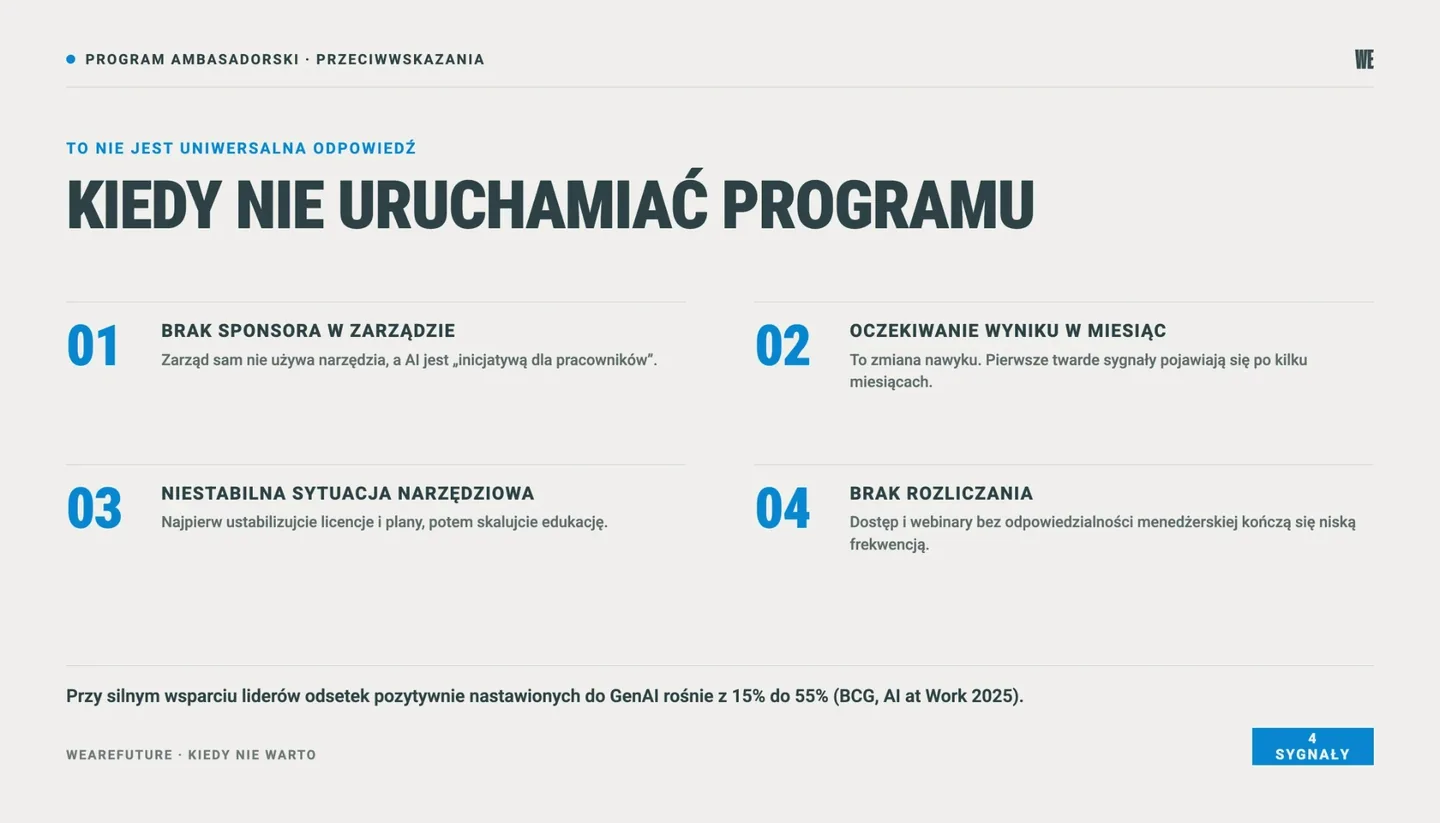
No sponsor on the board who uses the tool personally. A program in which AI is an “initiative for employees” but not for management never gains proper weight, regardless of the number of training sessions.
Expecting results in a month. This is a change of habit, not a technology rollout. The first hard signals appear after a few months of regular contact with the tool, and full results, including measuring process efficiency, need a longer horizon than one quarter.
An unstable tool situation in the company. If the organization has not yet decided which licenses and commercial plans it will ultimately run on, intensive hands-on training can be premature. Stabilize the tool layer first, then scale education.
No mechanism for accountability. Access to a tool and recurring webinars without managerial accountability for the outcome end in low attendance and no bottom-up ideas, regardless of the quality of the training materials.
From an ambassador pilot to an AI work culture in an international organization
The program described here is still running, and that is exactly what makes it valuable material. It shows the stage at which a large, international manufacturing organization learns not only to use tools, but also to make decisions about them: how much to pay, where to keep data, who gets a license first, how to measure whether the investment made sense.
The next steps of such a program, regardless of the organization, lead in a similar direction: from individual ambassadors to department workshops, from one tool to a deliberate portfolio of solutions and from ad hoc training to a structured AI strategy in the company, in which successive implementations share a common skills foundation, not a random set of licenses bought on impulse.
Planning an adoption program in an organization that operates in many countries and under pressure from data security requirements? Let's talk about an approach matched to your scale: 30 minutes, no commitment.
Book a call about an AI adoption program
Frequently asked questions about AI ambassador programs
How does an ambassador program differ from regular AI training?
Training ends on the day of the workshop. An ambassador program is a cycle lasting several months: a group of employees learns deeper and faster than the rest of the organization and then becomes a source of support and examples for their departments. The main difference is continuity: regular sessions, 1:1 consultations and an accountability mechanism instead of a one-off event.
How do you organize AI training for the whole company, not just for selected departments?
Start with a group of ambassadors from every department and country, not only from IT or marketing. This group goes through an in-depth workshop track on their own tasks, and the rest of the organization gets shorter inspiration sessions with examples from their industry. Ambassadors carry the knowledge into teams and collect improvement ideas. In a company of 2,200 people in many countries, this model raised the share of active users of Copilot, the company's main AI tool, from 33% to 49% in the first months.
How long does an AI ambassador program take in a large, international organization?
In our experience: at least three months of an intensive phase before the program turns into a self-sustaining community. In geographically dispersed organizations, with many decision-makers and data security requirements, this horizon often gets longer, especially when licensing decisions change during the program.
What do you do when the board wants to pause or cut the investment during the program?
Treat it as a normal part of a long program, not its end. The key is to protect what has already been built (the ambassador group, materials, habits) so that resuming after a break does not mean starting from scratch. We recommend clearly defining the conditions (for example a licensing decision, a budget for the next quarter) that must be met for the program to move forward.
Can you measure AI adoption before the program ends?
Yes, and you have to do it continuously, not only at the end. You need three sources in parallel: hard measurement from the admin panel of the given tool, a recurring survey of skills and barriers, and qualitative signals: attendance, the content of requests, activity on the ambassador channel. None of them alone gives a full picture.
Copilot or Claude for a large international organization?
It depends on the type of tasks and the existing infrastructure. Organizations deeply embedded in the Microsoft 365 ecosystem often start with Copilot because of integration and easy license management. For tasks that require deeper work with long, inconsistent documents and more flexibility in building their own solutions, teams also turn to Claude. A decision on the scale and cost of such a set of tools should also take data location and GDPR requirements into account.
What are the first signs that an ambassador program is no longer working?
Falling attendance at mandatory sessions, no submissions of own use cases despite an open call, and silence instead of questions and problems. Each of these signals on its own can be temporary. Several at once, lasting for a few weeks, require a quick response.
See also: Claude AI adoption in a Polish manufacturing company: case study (2026), on how to go in six months from a few enthusiasts to an organization that uses the tool every day. And Claude vs ChatGPT, Copilot and Gemini for business: which tool to choose for which tasks.
Sources
BCG, AI at Work 2025: Momentum Builds, but Gaps Remain (June 2025): the impact of leadership support on employee attitudes to GenAI.
WeAreFuture - own data from the adoption program described (Copilot admin panel, initial ambassador survey, 2025-2026).
